
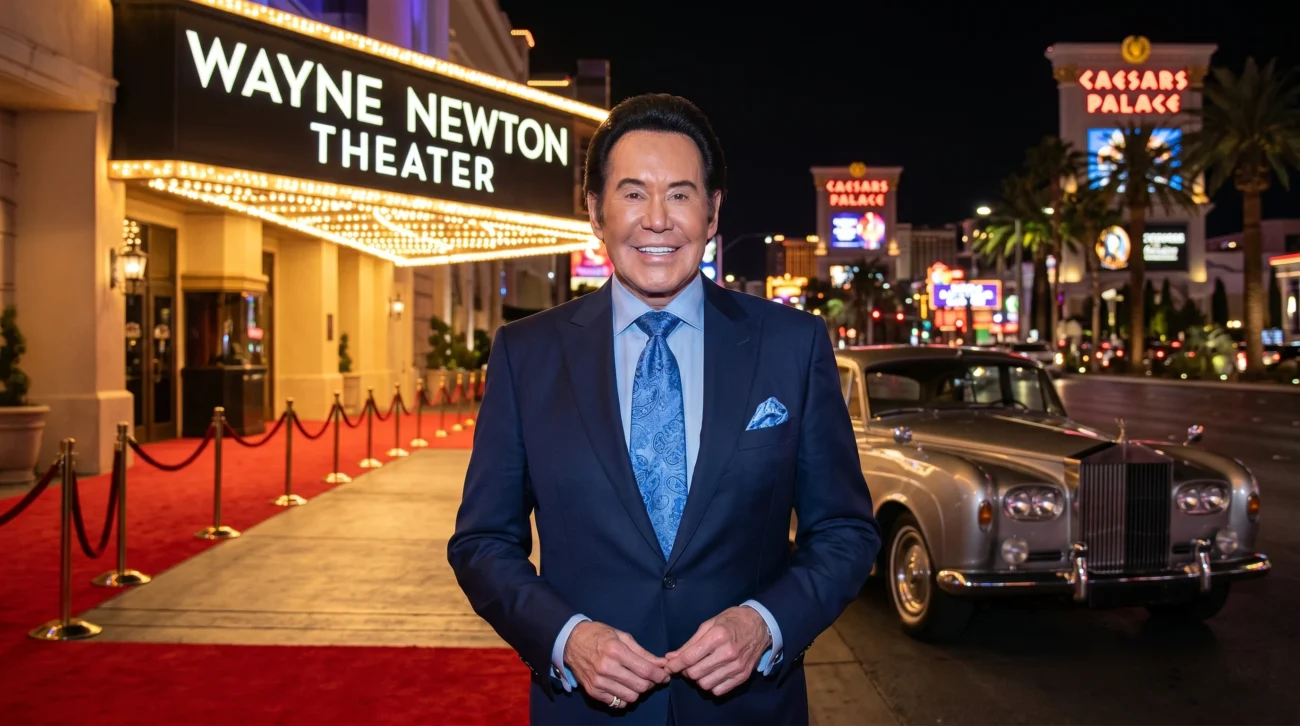
Wayne Newton has spent most of his life doing what few entertainers ever manage: becoming inseparable from a city. Long before Las Vegas became a revolving door for pop residencies, Newton was already its most dependable showman, a singer with a boyish tenor, a polished tuxedo image, and a work ethic that turned nightclub fame into a national brand. He has been called “Mr. Las Vegas” for decades, and the title has stuck because it feels less like a nickname than a job description.
His money story is just as dramatic as his career. Public estimates commonly place Wayne Newton’s net worth at around $50 million, but that figure is an estimate rather than a verified financial statement. Newton’s life includes huge casino contracts, hit records, real estate, horses, bankruptcy, tax disputes, and a long second act on the Strip. To understand his wealth, you have to understand the boy from Virginia who became one of the last great showroom stars.
Early Life and Family
Wayne Newton was born Carson Wayne Newton on April 3, 1942, in Norfolk, Virginia. His father, Patrick Newton, worked as an auto mechanic, and his mother, Evelyn Marie Smith, helped raise a family that moved through modest circumstances before Wayne became famous. Newton has often been described as having Native American ancestry through his parents, a part of his background that became part of his public biography over the years. His early childhood was shaped less by glamour than by health problems, family movement, and an unusually early pull toward performance.
Music entered his life when he was still very young. Newton learned piano, guitar, and steel guitar as a child, and by the time most children were settling into school routines, he was already performing with his older brother, Jerry. The brothers worked as a duo, singing country and pop material in local venues and on radio. That early exposure gave Newton something more valuable than polish: it taught him how to read an audience before he was old enough to drive.
Because Newton struggled with asthma, his family eventually moved west in search of a drier climate. They settled in Phoenix, Arizona, where the brothers continued performing and where Wayne’s career began to look less like a childhood hobby and more like a family business. He attended North High School in Phoenix, but music kept pulling him away from ordinary teenage life. By his mid-teens, Newton was already on the road to Las Vegas, the city that would define him.
The Teenage Performer Who Found Las Vegas
Newton first performed in Las Vegas as a teenager, and that fact remains one of the keys to his entire story. He did not arrive as a fully formed adult star with a record label and national campaign behind him. He arrived as a young performer with an unusual voice, a clean-cut image, and enough stage confidence to survive rooms that could be unforgiving. Las Vegas in those years was a city of lounges, showrooms, gamblers, tourists, and performers who had to win people in real time.
The Newton brothers were discovered by entertainment figures who saw something marketable in their act. Wayne’s youth became part of the appeal, but it also made his professionalism stand out. He was working in adult spaces while still learning who he was as a performer. That combination of innocence and discipline would become central to his public image.
By the early 1960s, Wayne Newton had begun separating himself from the idea of being only one half of a brother act. His voice, high and instantly recognizable, could divide listeners, but it also made him impossible to confuse with anyone else. In entertainment, that matters. A distinctive voice can be a risk, but for Newton it became a signature.
Breakthrough With “Danke Schoen”
Newton’s national breakthrough came with “Danke Schoen,” released in 1963. The song, originally associated with producer Bobby Darin’s circle, became Newton’s calling card and remains the recording most closely linked to him. It had a bright, swinging quality that fit his youthful image and the polished show-business style of the period. More than six decades later, many listeners still hear the title and immediately think of Newton.
“Danke Schoen” did more than give him a hit. It gave him a musical identity that could travel beyond Las Vegas. The song later gained renewed cultural life when it was used memorably in the 1986 film “Ferris Bueller’s Day Off,” introducing Newton’s sound to younger audiences who had no direct memory of his early career. That kind of afterlife is rare and valuable, especially for a performer whose main financial engine was live work.
The hit also helped Newton bridge two entertainment worlds. He could appear on television as a recording artist, but he could also return to Vegas as a showroom act with national name recognition. In the 1960s, that combination mattered. Television made a performer familiar, but Las Vegas made that familiarity pay night after night.
Building the “Mr. Las Vegas” Brand
Wayne Newton’s greatest career achievement was not one song, one contract, or one television appearance. It was the construction of a persona so closely tied to Las Vegas that his name became shorthand for the city’s classic entertainment era. He was not a rock rebel or a folk poet. He was a polished host, singer, bandleader, and crowd-pleaser in the old Vegas sense.
His shows blended music, storytelling, charm, and stamina. Newton understood that Las Vegas audiences were not always coming for a concert in the modern sense. Many were buying an evening, a memory, and a brush with glamour. He gave them that with discipline, often performing at a pace that would exhaust entertainers half his age.
Over time, the nickname “Mr. Las Vegas” became commercially powerful. It allowed Newton to sell not only songs but continuity. As casinos changed ownership, hotels were demolished, and musical tastes shifted, Newton represented a link to the city’s older mythology. That link became one of his most valuable assets.
Career Highs and Major Milestones
Newton’s career stretched across records, television, film, and thousands of live performances. After “Danke Schoen,” he continued releasing music and scored another major hit with “Daddy, Don’t You Walk So Fast” in 1972. The song reached a wide audience and gave him one of the biggest chart successes of his recording career. It also showed that he was not confined to the early 1960s sound that first made him famous.
Television helped keep him in American homes. Newton appeared on variety shows, talk shows, specials, and later reality and competition programs. He had the kind of personality that worked well in guest appearances because audiences already understood the frame: Wayne Newton meant Vegas, showmanship, and old-school entertainment. That recognition gave him career insurance during periods when radio was less central to his success.
Film appearances added another layer to his public image. He appeared in movies including “Licence to Kill,” “The Adventures of Ford Fairlane,” and “Vegas Vacation,” often drawing on the audience’s awareness of his real-life persona. These roles were not the core of his fortune, but they helped preserve his visibility. For a live performer, visibility often turns into ticket sales.
Wayne Newton Net Worth and How He Made His Money
The most common public estimate of Wayne Newton’s net worth is about $50 million. That number should be treated carefully because Newton’s private finances are not fully public. He has owned real estate, performance rights, memorabilia, and business interests, and he has also faced debts, legal disputes, and tax issues. The honest answer is that Newton appears to be wealthy, but no outside estimate can capture his finances with exact precision.
The largest source of his money has been live performance. Newton became one of Las Vegas’s most bankable entertainers because he could work consistently, draw tourists, and embody the city’s entertainment brand. At his peak, he was linked to major casino contracts, including a widely reported late-1990s deal with the Stardust. Even allowing for expenses, taxes, and business costs, that level of work points to enormous lifetime earnings.
His income also came from recordings, royalties, television, film, appearances, and licensing tied to his public identity. “Danke Schoen” and “Daddy, Don’t You Walk So Fast” gave him lasting music value, but Newton’s wealth was never only about records. He made money the way classic Vegas headliners did: by being present, reliable, and marketable over a very long period. That longevity is the real foundation of the Wayne Newton net worth conversation.
The Stardust Deal and Peak Earning Power
One of the most discussed moments in Newton’s financial career came in 1999, when he signed a major deal with the Stardust Resort and Casino. Contemporary reporting described the contract as one of the richest entertainment deals in Las Vegas history at the time. The arrangement reportedly called for Newton to perform exclusively at the Stardust for many weeks each year. Whether every headline number translated into personal income is another matter, but the deal showed how valuable he remained.
Casino contracts are often misunderstood by the public. A reported contract value does not equal a performer’s take-home pay. Production costs, musicians, management, taxes, insurance, and business expenses can all reduce the final number. Still, only a small group of entertainers ever command contracts large enough to become news stories on their own.
That deal also showed the difference between Newton and many recording stars. Some artists depend on album cycles or chart momentum. Newton depended on the ability to sell a room repeatedly, year after year. That made him valuable to casinos in a way that was both practical and symbolic.
Bankruptcy and Financial Setbacks
Newton’s wealth story includes serious setbacks. In 1992, he filed for Chapter 11 bankruptcy protection, with debts reported at roughly $20 million. The filing was a major public moment because it cut against the image of an entertainer who seemed permanently prosperous. It also showed how complicated celebrity finances can become when lawsuits, taxes, real estate, and business obligations collide.
Chapter 11 bankruptcy does not mean a person has no future earning power. It is a legal process that allows debts to be reorganized while the person or business continues operating. In Newton’s case, the filing did not end his career. He returned to the stage, rebuilt parts of his business life, and remained a recognizable draw in Las Vegas.
The bankruptcy remains important because it prevents a simplistic reading of his net worth. Newton made extraordinary sums, but he also faced extraordinary obligations. His story is not just about accumulation. It is about recovery, reputation, and the ability to keep working after public financial embarrassment.
Casa de Shenandoah and the Cost of a Dream
No property is more closely tied to Wayne Newton than Casa de Shenandoah, his former estate in the Las Vegas area. The property was famous for its white mansion, horse facilities, exotic animals, memorabilia, and the sense that it represented Newton’s private kingdom. For fans, it was a physical expression of his success. For Newton, it was also deeply personal.
The estate later became part of a complicated business plan to turn it into a public attraction. That effort brought outside investors, disputes, neighborhood attention, and legal conflict. Casa de Shenandoah eventually opened to the public for a period, offering visitors access to Newton’s memorabilia and the mythology surrounding his life. But the project did not become a simple or lasting triumph.
The property’s later sale underscored how difficult celebrity real estate can be. A famous estate can carry emotional value and public fascination without producing the financial result people expect. Large properties also cost money to maintain, especially when they include animals, staff, security, and specialized facilities. Casa de Shenandoah remains one of the clearest examples of how Newton’s wealth was tied to assets that were both valuable and expensive.
Marriage, Children, and Private Life
Wayne Newton has been married twice. His first marriage was to Elaine Okamura, whom he married in 1968. The couple had a daughter, Erin Newton, before divorcing in 1985. Newton’s family life during those years unfolded alongside the demands of a career that required constant public visibility.
In 1994, Newton married Kathleen McCrone, a lawyer from Ohio. The couple have a daughter, Lauren Ashley Newton, born in 2002. Kathleen has often appeared with him at public events, and their marriage has been part of his later-life public image. Unlike some entertainers whose personal lives overshadow their work, Newton has generally kept the focus on his career and family stability.
His private life has still drawn attention because fame makes even ordinary family facts public. That said, Newton has not built his celebrity around confessional exposure. He belongs to an older school of entertainment, where a performer’s home life was acknowledged but not endlessly opened for public inspection. That reserve has helped preserve a measure of dignity around his family story.
Horses, Animals, and a Lesser-Known Passion
One meaningful part of Newton’s life is his long devotion to Arabian horses. He became a serious breeder and owner, and his horses were closely associated with Casa de Shenandoah. This was not a casual celebrity hobby. Newton’s involvement with Arabian horses became part of his identity outside the showroom.
The horses also reflected something about his personality. Newton has often presented himself as a caretaker of tradition, whether in music, Las Vegas history, or animal breeding. His estate was not only a display of wealth; it was also a place built around interests that required time, knowledge, and emotional investment. That made the later conflicts over the property even more personal.
Animal ownership on that scale also comes with real costs. Feeding, veterinary care, land, staff, and facilities can turn a passion into a major financial commitment. This is another reason Newton’s net worth cannot be understood only by counting contracts. His lifestyle included assets that were beautiful, meaningful, and expensive to sustain.
Public Image and Cultural Influence
Wayne Newton’s public image has always carried a mix of admiration and parody. To fans, he represents grace, professionalism, and the Vegas tradition of giving audiences a full evening of entertainment. To comedians and pop culture, he has sometimes represented the excess or theatricality of old Las Vegas. Newton survived both versions because the image was strong enough to absorb jokes without collapsing.
His influence is clearest in the way Las Vegas residencies are now understood. Today, global pop stars routinely build major runs around casino theaters, but Newton helped prove that a performer could become a standing attraction in the city. He was not passing through; he was part of the city’s identity. That is a different kind of fame from a hit single or a movie role.
Younger audiences may know him through references, cameos, or the sound of “Danke Schoen” in film and television. Older audiences may remember the records, the television spots, and the showroom years. Across generations, Newton’s name still means something specific. In entertainment, that kind of recognition is rare.
Recent Work and Current Status
Newton has continued performing into his eighties, especially in Las Vegas. His later shows have often been built around a more intimate format, combining music with stories from his career. That approach suits a performer whose life has become part of the attraction. Audiences are not only buying a songbook; they are buying access to memory.
His current public status is that of a living Las Vegas institution. He is no longer competing with young pop stars for radio attention, and he does not need to. His value comes from longevity, familiarity, and the fact that he personally witnessed eras of entertainment that most modern performers only reference. That gives his shows a built-in sense of history.
Newton’s continued work also affects the way people think about his net worth. He is not simply a retired celebrity whose fortune depends on old royalties and investments. He has remained an active performer, which means his earning story is still alive. That makes his career unusual even among long-lasting entertainers.
Why People Still Search for Wayne Newton Net Worth
Search interest in Wayne Newton net worth comes from more than curiosity about a dollar figure. Readers are often trying to reconcile two images: the wealthy Las Vegas icon and the entertainer who once filed for bankruptcy. That contrast makes the question more interesting than a simple ranking of celebrity fortunes. Newton’s money story contains success, risk, loss, and reinvention.
There is also fascination with the economics of classic Las Vegas. People understand modern celebrity residencies because they are heavily promoted and often tied to global pop stars. Newton came from an older system of lounges, showrooms, handshake reputations, and relentless live work. His fortune shows how that system could make a performer rich without making him immune to financial trouble.
The truth is, Newton’s estimated net worth matters because it opens the door to a larger biography. It raises questions about how entertainers build wealth, how they lose it, and how reputation can remain valuable after setbacks. Newton’s answer is unusually human. He made money by becoming dependable, and he endured by staying recognizable.
Frequently Asked Questions
What is Wayne Newton’s estimated net worth?
Wayne Newton’s net worth is commonly estimated at around $50 million. The figure is not officially confirmed by Newton, so it should be treated as a public estimate rather than a verified accounting. His assets and debts are private, and his financial history includes both major earnings and major obligations.
How did Wayne Newton become famous?
Newton became famous through a combination of Las Vegas performances and national music success. His 1963 recording of “Danke Schoen” became his signature song and introduced him to a broad audience. He later strengthened his fame through casino residencies, television appearances, films, and decades of live shows.
Why is Wayne Newton called “Mr. Las Vegas”?
Newton is called “Mr. Las Vegas” because he became one of the city’s most enduring and recognizable entertainers. He performed in Las Vegas from his teenage years and built a career around the showroom tradition. Over time, his name became closely linked with the city’s classic entertainment identity.
Did Wayne Newton really file for bankruptcy?
Yes, Newton filed for Chapter 11 bankruptcy protection in 1992. Reports at the time said he had debts of roughly $20 million. The filing was a serious financial setback, but it did not end his career or erase his earning power.
Is Wayne Newton still performing?
Newton has continued performing in Las Vegas in his later years. His recent shows have focused on music, stories, and memories from his long career. That continued activity is part of why he remains relevant to audiences and why his net worth still draws interest.
Who is Wayne Newton married to?
Wayne Newton is married to Kathleen McCrone, a lawyer whom he married in 1994. He was previously married to Elaine Okamura from 1968 until their divorce in 1985. Newton has two daughters, Erin from his first marriage and Lauren from his second marriage.
What happened to Casa de Shenandoah?
Casa de Shenandoah was Newton’s famous Las Vegas-area estate and ranch. It became known for its mansion, Arabian horses, memorabilia, and later its attempt to operate as a public attraction. The property eventually left Newton’s control and was later sold, becoming one of the most discussed chapters in his financial history.
Conclusion
Wayne Newton’s life is not the story of a singer who simply got rich and stayed rich. It is the story of a performer who built a fortune through stamina, charm, and a rare bond with Las Vegas, then faced the kinds of financial storms that can follow large earnings and larger obligations. His estimated net worth matters, but it is only one piece of the portrait.
What makes Newton compelling is his durability. He survived changing tastes, public money troubles, legal fights, and the fading of the entertainment world that first made him famous. Through it all, he remained recognizable, bookable, and tied to a city that still understands the value of a living legend.
The phrase “wayne newton net worth” may begin as a search for a number, but it leads to a fuller question about what a lifetime in show business really produces. In Newton’s case, it produced wealth, pressure, reinvention, and a legacy that cannot be measured only in dollars. He remains one of the last great symbols of classic Las Vegas, and that may be his most lasting asset.
