
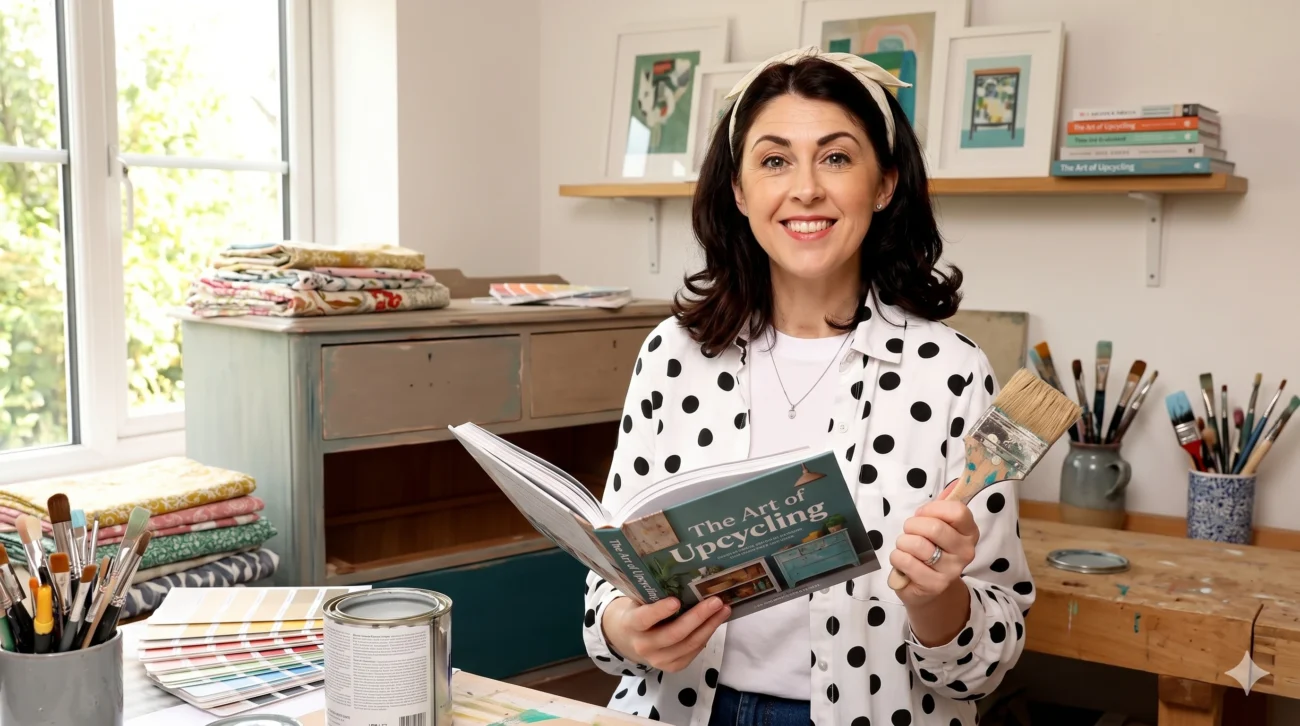
Gemma Longworth’s public image is built around a simple act that feels more radical than it first appears: she looks at things other people have given up on and asks what they might still become. On television, that has meant rescuing tired furniture, worn objects, and forgotten household pieces on Find It, Fix It, Flog It. Away from the cameras, it has meant something deeper: using art, craft, and upcycling as ways to support people through grief, stress, memory, and change.
Longworth is best known to many viewers as a British upcycler and restorer with a warm, practical presence on screen. But the fuller story is not just about television or interiors. She is an artist, author, workshop leader, therapeutic arts practitioner, and founder of Hidden Gems, a creative support service rooted in craft, sustainability, and wellbeing. Her career has grown from the belief that making something by hand can help people feel steadier, more capable, and more connected to the world around them.
That combination explains why her name attracts so much search interest. Some readers want the basic biography: her age, hometown, career, family, husband, children, and net worth. Others know her from television and want to understand what she does now. The most honest portrait of Gemma Longworth begins with what can be verified, treats private matters carefully, and follows the thread that runs through her work: repair as both a practical skill and a human instinct.
Early Life and Family Background
Gemma Longworth is publicly associated with Liverpool and the North West of England, a setting that has shaped much of her professional work. Public biographies describe her as having studied applied arts, textiles, and therapeutic arts before building a career that moved through teaching, community workshops, hospitals, charities, television, and publishing. While many online biography pages attempt to fill in details about her childhood, parents, siblings, and full family background, much of that information is not confirmed through reliable public sources.
What can be said with confidence is that Longworth’s adult life and career have been closely tied to creative education and hands-on making. Her path was not that of a presenter who later discovered craft for television. The evidence points in the other direction: she was already working as an artist, maker, teacher, and upcycler before television widened her audience. That distinction matters because it explains the ease she brings to restoration work on screen.
Public records connected with Gemma’s Hidden Gems CIC list Gemma Catherine Longworth with a birth month and year of May 1984. Based on that public filing, she would be 42 in May 2026, though her full date of birth is not something that should be repeated unless confirmed by her directly or through a stronger source. Many websites claim more exact personal details, but careful biography writing should not treat repeated online claims as proof. In Longworth’s case, the reliable public record is strongest around her education, work, and community projects, not her private family history.
Her public persona suggests someone shaped by practical creativity rather than celebrity culture. She speaks through projects, workshops, repairs, and the visible satisfaction of turning discarded material into something useful again. That makes her different from many lifestyle figures whose work is built mainly around personal branding. Longworth’s public identity rests less on self-disclosure and more on what she can teach people to make, mend, and reimagine.
Education and First Creative Ambitions
Longworth’s creative background begins with formal training in art and design. Public author biographies state that she studied applied arts and later completed a master’s degree in textiles. She also pursued postgraduate study in therapeutic arts, a field that connects creative practice with emotional support, self-expression, and wellbeing. Those areas of study help explain why her later career does not sit neatly in one category.
Applied arts gave Longworth a foundation in making things that live in the real world, not only in galleries or classrooms. Textiles offered another layer, bringing attention to surface, texture, repair, fabric, memory, and domestic objects. Therapeutic arts then added a human and emotional frame to the work. The result is a career that treats craft not as decoration alone, but as something that can hold feeling, memory, and purpose.
Before she became widely known on television, Longworth worked in creative teaching and workshop settings. Public profiles connect her with hospitals, schools, colleges, charities, and community organizations across the United Kingdom. This kind of work requires a different kind of skill from studio practice. It asks the artist to read a room, adapt to different needs, and make creativity feel possible for people who may be nervous, grieving, unwell, or unsure of themselves.
That early work became the foundation for everything that followed. Television rewarded her ability to explain creative transformation clearly, but that ability was likely sharpened long before the cameras arrived. Teaching craft to different age groups and community settings demands patience, clarity, and warmth. Longworth’s screen presence feels natural because it appears to come from years of helping people make things with their own hands.
Building a Career Around Upcycling
Upcycling sits at the center of Gemma Longworth’s public career. At its simplest, upcycling means taking something old, unwanted, damaged, or unfashionable and changing it into something with renewed use or appeal. In practice, it can involve sanding, painting, reupholstering, repairing joints, replacing handles, altering shapes, refreshing surfaces, or completely rethinking how an object should function. Longworth’s work presents upcycling as practical, affordable, creative, and emotionally satisfying.
Her approach is not only about making old furniture look prettier. It is about teaching people to see potential before they throw something away. A scratched table might have good proportions under a tired finish. A chair with dull fabric might need structure, color, and attention rather than replacement. A cabinet that looks dated in one room might become useful again with a cleaner surface, new hardware, or a bolder design choice.
This matters because upcycling has grown alongside wider concerns about waste, cost, and fast consumption. Furniture and household goods can be expensive to replace, and many discarded items still contain usable materials. Longworth’s work speaks to people who want their homes to feel personal without spending heavily or buying everything new. It also appeals to viewers who like the visible drama of transformation: the before, the process, and the reveal.
But here’s the thing. Upcycling only works well when it respects the object. Longworth’s public work is strongest when it shows judgment as well as enthusiasm, because not every item is worth saving in the same way. A good restorer knows when to repair, when to repaint, when to preserve, and when to walk away from a project that is unsafe or structurally poor.
Television Breakthrough on Find It, Fix It, Flog It
Gemma Longworth became best known to a national audience through Find It, Fix It, Flog It, the British restoration and upcycling programme associated with Channel 4. The show’s appeal is straightforward: unwanted or overlooked items are found, repaired, reworked, and sold, often revealing hidden value in things that might otherwise have been discarded. For Longworth, the format was a natural fit because it allowed her to bring craft skill, design instinct, and teaching ability to a broad audience. She was not pretending to be a maker for television; she was doing work that already matched her background.
On the programme, Longworth became familiar as someone who could turn tired furniture and preloved items into pieces with renewed character. Her role connected with viewers because she made restoration feel approachable rather than intimidating. She could talk through a project without making the viewer feel excluded by jargon. That is one reason craft and repair television continues to attract loyal audiences: it lets people imagine doing something similar in their own homes.
The programme also helped place Longworth within a popular British tradition of repair television. Shows built around antiques, reclamation, renovation, and upcycling have long appealed to viewers who enjoy seeing old objects rescued from neglect. What sets Longworth apart is the way her work overlaps with creative wellbeing. She is not only interested in whether an item can sell; she is interested in what making and repairing can do for the person doing it.
Television brought her visibility, but it did not reduce her to a screen personality. Longworth’s public profile continued to include workshops, community projects, therapeutic art sessions, and later a book. That mix has given her career durability beyond a single programme. Viewers may have found her through Find It, Fix It, Flog It, but the wider story is about what she has built around the idea of creative repair.
Hidden Gems and Bereavement Support Work
Hidden Gems is one of the most meaningful parts of Longworth’s career. Public materials describe it as a creative support service offering therapeutic art and craft workshops with Gemma Longworth. Its work includes bereavement support, mental wellbeing sessions, sustainability workshops, team building, creative support groups, and one-to-one art sessions. This is where Longworth’s training in therapeutic arts becomes most visible.
The name Hidden Gems also captures the spirit of her broader work. In furniture, she looks for hidden value in objects that have been overlooked. In people, especially those moving through grief or stress, the aim is not so different: to create a setting where expression, memory, and confidence can surface. A workshop may involve painting, decoupage, journaling, drawing, memory boxes, recycled art, mending, or other hands-on activities.
Longworth’s work has been connected publicly with Alder Hey Children’s Hospital and The Alder Centre, which provides bereavement support. Public information also links Hidden Gems with groups and clients across charity, community, hospital, and education settings. These connections show that her craft practice has moved well beyond hobby teaching. It has become part of a wider effort to use creativity as a form of support.
There is a careful distinction to make here. Creative workshops can be therapeutic without being the same as formal clinical therapy. Longworth’s work is best understood as creative support, wellbeing practice, and therapeutic arts activity rather than medical treatment. That distinction protects both the seriousness of her work and the reader’s understanding of what such sessions can realistically offer.
Craft Your Cure and Her Move Into Publishing
Longworth’s book, Craft Your Cure: 25 Craft and Upcycling Projects to Heal and Bring Joy, brought her approach to a wider audience in print. Published by Watkins, the book presents projects that combine craft, upcycling, emotional care, memory, and home-making. Its title reflects the emotional promise at the heart of Longworth’s public work, though it is best read as a creative and personal idea rather than a medical claim. The book positions making as a way to restore focus, comfort, and confidence.
The projects associated with the book range across paper craft, jewelry, cushions, clay, doodling, blankets, clothing repair, and furniture upcycling. That range matters because it makes the book accessible to people with different skills, budgets, and emotional needs. Someone who is not ready to tackle a piece of furniture might still find comfort in drawing, stitching, painting, or making a memory object. Longworth’s message is that creativity does not have to begin with mastery.
The book also reflects a larger cultural shift. More people now think of craft not only as a pastime, but as a way to slow down, manage stress, personalize a home, and connect with memory. Longworth did not invent that movement, but she gives it a clear and practical voice. Her work has always been at its best when it invites ordinary people to start where they are.
For a television craft figure, publishing was a logical next step. A show can inspire people in the moment, but a book allows them to return to a project, follow instructions, and work at their own pace. It also lets Longworth explain the emotional side of making in a fuller way. In that sense, Craft Your Cure is less a celebrity product than a continuation of the workshops and values that already defined her career.
Marriage, Children and Private Life
Many readers search for Gemma Longworth’s husband, marriage, children, and family life. That interest is understandable because television personalities often feel familiar to viewers, especially when they appear in warm, domestic, creative formats. But Longworth has not built her public career around exposing her private relationships. Reliable public information about her spouse, children, or household is limited.
Some websites claim details about her marriage or personal relationships, but those claims are often unsourced or repeated without clear evidence. A responsible biography should not turn weak online claims into apparent fact. Unless Longworth has confirmed a relationship, marriage, or family detail in a reliable public setting, it should be treated as private. Curiosity does not create a public record.
What can be said is that Longworth’s work often touches family life through memory, loss, and home. Her bereavement support projects and craft activities are closely tied to the emotional world of families, children, parents, carers, and communities. That does not mean readers are entitled to know the details of her own family. It means her public work speaks to experiences many families recognize.
This privacy may be one reason Longworth’s public profile feels grounded. She has shared enough of her professional values for people to understand her work, without turning every part of her life into content. In an era when many public figures trade heavily on personal exposure, that restraint is noticeable. It allows the work itself to stay at the center.
Income Sources and Net Worth
Gemma Longworth’s income appears to come from several professional areas: television presenting, creative workshops, upcycling and restoration work, public appearances, teaching, author royalties, and activity connected with Hidden Gems. Those are reasonable income streams for someone with her public profile and skill set. What is not publicly verified is a precise net worth figure. Any exact number should be treated with caution unless supported by financial records or reliable reporting.
Online searches may produce estimates of Longworth’s net worth, but most such figures are not backed by evidence. Celebrity net worth pages often rely on guesswork, copied assumptions, or broad comparisons with other television personalities. Longworth is not a mainstream celebrity with publicly reported contracts, major endorsement deals, or disclosed business earnings. That makes precise valuation unrealistic.
Public company records connected with Gemma’s Hidden Gems CIC confirm formal business activity, but they do not provide a clear picture of her personal wealth. A community interest company also has a different public purpose and structure from a conventional private profit-making business. It should not be treated as simple proof of personal income. The better conclusion is that Longworth has built a diversified creative career, not that her personal fortune can be reliably calculated.
Her real professional value is easier to measure in influence than in money. She has turned craft and upcycling into a platform that spans television, workshops, social good, publishing, and public education. That kind of career is not always captured well by celebrity finance estimates. It is built through trust, repeat work, practical skill, and a clear connection with audiences.
Public Image and Why Viewers Respond to Her
Gemma Longworth’s public image is warm, practical, and unpretentious. Viewers respond to her because she makes creativity feel possible rather than exclusive. She does not seem to be selling perfection. She is inviting people to try, make mistakes, and see potential in things they might otherwise overlook.
That quality is especially important in the upcycling world. A presenter can easily make restoration feel either too polished or too messy for beginners. Longworth occupies a more encouraging middle ground. She shows enough skill to be credible, but not so much distance that viewers feel they could never begin.
Her work also appeals because it meets several needs at once. It speaks to people who want to save money, reduce waste, improve their homes, learn a craft, or find a calming activity. It also speaks to people who understand that objects can carry feeling. A repaired chair, a memory box, or a mended piece of clothing can become more than a project; it can become a way of holding on, letting go, or starting again.
That emotional layer gives her public image depth. She is not simply a television upcycler with a good eye for color and finish. She is a maker who has connected restoration with care. That makes her work feel both useful and personal.
Current Work and Where Gemma Longworth Is Now
As of the most recent public information available, Gemma Longworth continues to be active as an artist, upcycler, presenter, author, and founder of Hidden Gems. Her current public profile is centered on creative workshops, therapeutic art sessions, sustainability projects, television-related recognition, and her published book. Hidden Gems presents her work as covering individuals, groups, events, festivals, schools, charities, and organizations. That range suggests a career still expanding across different forms of public and community engagement.
The creation of Gemma’s Hidden Gems CIC in 2024 marked an important formal step in her public work. A community interest company structure fits the social purpose visible in her projects, especially around bereavement, wellbeing, and accessible creativity. It also suggests that Longworth’s work is not simply a freelance creative brand. It has become an organized service with community-facing aims.
Her book publication added another layer to her current career. With Craft Your Cure, Longworth moved from demonstrating and leading activities to offering readers a lasting guide they can use in private. That matters for people who may not be able to attend a workshop or who discover her work through television and want a practical way to begin. The book also strengthens her standing as a public voice in craft and creative wellbeing.
Longworth’s current status is best described as a working creative professional with a growing public platform. She is not a tabloid celebrity, and her public life is not defined by scandal or spectacle. Her relevance comes from a steadier place: people want homes with character, lives with meaning, and practical ways to feel better. Longworth’s work speaks to all three.
Lesser-Known Details That Explain Her Career
One lesser-known but important part of Longworth’s story is that her work with objects and her work with people are not separate. Upcycling teaches patience, problem-solving, and the ability to see value beneath damage or neglect. Therapeutic arts work asks for many of the same instincts, though applied to human experience rather than furniture. That parallel helps explain why her career feels coherent even though it crosses different fields.
Another meaningful detail is her grounding in textiles. Textile training often gives artists a strong sense of touch, repair, layering, and domestic memory. Fabric carries use in a visible way: it frays, fades, stretches, stains, and softens. That sensitivity shows up naturally in someone who works with old objects and emotional memory.
Her hospital and community workshop background is also central. It is one thing to make beautiful work in a studio, and another to guide a child, a grieving adult, a hospital staff member, or a nervous beginner through a creative process. The second kind of work asks for empathy as much as technical skill. Longworth’s public materials suggest she has spent years developing that combination.
Not many people know this, but the most lasting craft careers are often built outside the spotlight before they are noticed by television. Longworth’s profile fits that pattern. The television opportunity made her more visible, but the authority came from the years of practice behind it. That is why her work feels less like a performance and more like an extension of who she already was professionally.
Frequently Asked Questions
Who is Gemma Longworth?
Gemma Longworth is a British artist, furniture upcycler, restorer, television presenter, author, and creative workshop leader. She is best known to many viewers for her work on Find It, Fix It, Flog It, where she restores and reimagines unwanted items. She is also the founder of Hidden Gems, a creative support service focused on therapeutic art, craft, bereavement support, wellbeing, and sustainability.
How old is Gemma Longworth?
Public company records connected with Gemma Catherine Longworth list her birth month and year as May 1984. Based on that information, she would be 42 in May 2026. Her full date of birth is not widely confirmed through stronger public sources, so exact birthday claims should be treated carefully.
Is Gemma Longworth married?
Reliable public information about Gemma Longworth’s marriage or spouse is limited. Some websites claim personal relationship details, but many do not provide clear evidence. Longworth has kept much of her private life away from the center of her public career, so unverified claims about her husband or family should not be treated as confirmed fact.
Does Gemma Longworth have children?
There is no strong public record confirming details about Gemma Longworth’s children. Searches often produce speculative biography pages, but those are not the same as reliable reporting. Because Longworth’s public work is focused on craft, television, workshops, and community support, her private family life should be discussed only where she has chosen to make it public.
What is Gemma Longworth’s net worth?
Gemma Longworth’s exact net worth is not publicly verified. Her likely income sources include television work, workshops, creative projects, publishing, restoration, appearances, and activity connected with Hidden Gems. Any precise online figure should be understood as an estimate unless it is backed by financial records or reliable reporting.
What is Gemma Longworth’s book?
Gemma Longworth is the author of Craft Your Cure: 25 Craft and Upcycling Projects to Heal and Bring Joy. The book brings together craft, upcycling, memory, comfort, and home-making through practical projects. It reflects the same themes that run through her television and workshop career: repair, creativity, sustainability, and emotional support.
What is Hidden Gems?
Hidden Gems is Gemma Longworth’s creative support service. It offers therapeutic art and craft workshops, including bereavement support, mental wellbeing sessions, sustainability projects, group workshops, and one-to-one creative support. The project reflects Longworth’s belief that making things by hand can help people process emotion, build confidence, and reconnect with creativity.
Conclusion
Gemma Longworth’s story is not the usual television biography built around fame, exposure, and constant reinvention. It is the story of a maker who found a public platform because her skills were already useful, warm, and clear. She became known through restoration television, but the heart of her career is broader than any single programme.
What makes her work memorable is the way she connects repair with care. A damaged chair, an old cabinet, a scrap of fabric, or a blank journal page can become a starting point. In Longworth’s hands, craft is not a luxury activity for people with perfect homes and endless time. It is a practical route back to attention, confidence, and meaning.
Her biography also shows the value of treating public figures carefully. There are things we can know about Gemma Longworth: her work, her training, her book, her television career, her company, and her public mission. There are also things that remain private or weakly sourced, and they should be left that way unless she chooses otherwise.
For readers discovering her now, the point is not only who Gemma Longworth is, but what her career asks people to notice. The overlooked object may still have use. The small creative act may still matter. The work of repair, whether in a room or in a life, often begins with seeing value where others have stopped looking.
