
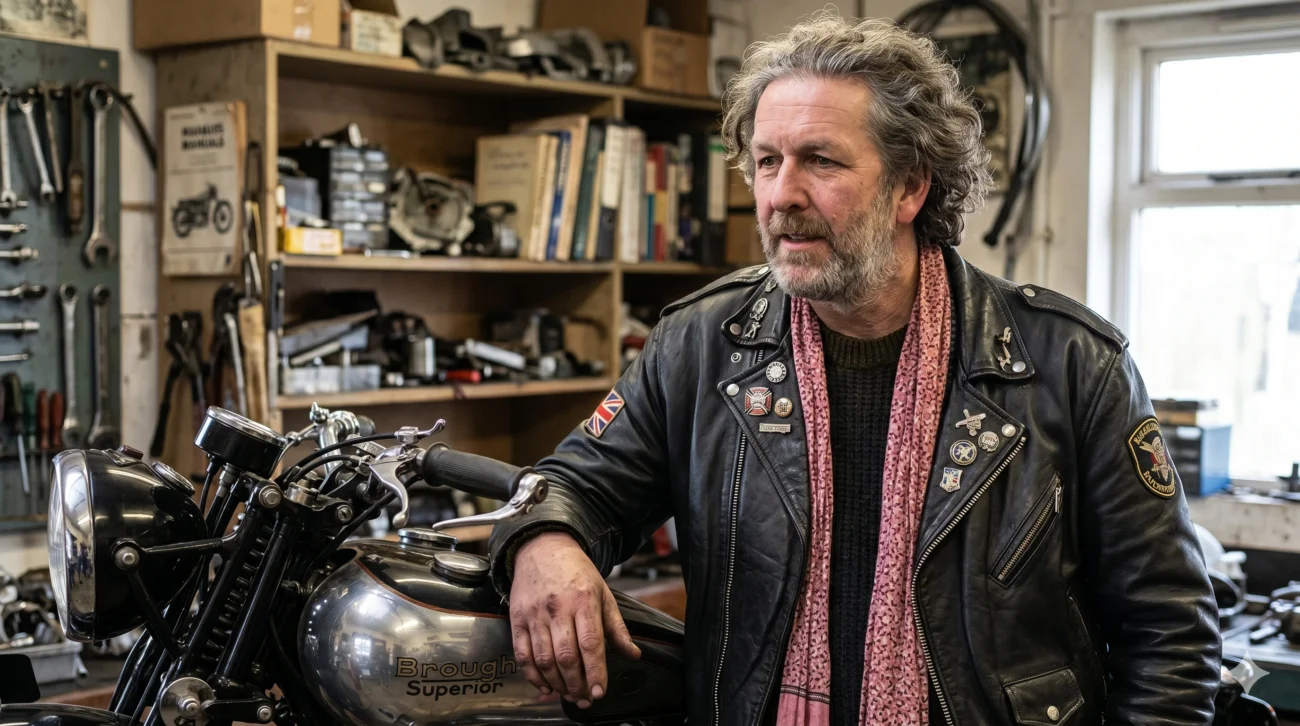
Sam Lovegrove became familiar to many viewers not by chasing the spotlight, but by standing beside broken machines and making sense of them. On British motoring shows with Henry Cole, he often appears as the calm mechanical mind in the room, the man who can look past rust, missing parts, and wishful thinking to decide whether an old motorcycle or vehicle has another life in it. That quiet authority has made him a favorite among viewers who like restoration television for the craft rather than the drama.
The public curiosity around Sam Lovegrove is easy to understand. He is recognizable from television, yet he has kept much of his private life out of public view. He is known as a motorcycle engineer, restorer, collector, and television personality, but he has never seemed especially interested in turning that visibility into celebrity for its own sake. The result is a figure who feels both familiar and slightly elusive, respected more for practical knowledge than personal exposure.
Early Life and Private Background
Reliable public information about Sam Lovegrove’s early life is limited. His exact date of birth, hometown, parents, siblings, and school background are not widely confirmed in strong public sources. That absence has led some biography pages to fill the gap with unsourced claims, but a careful account should not treat repeated internet detail as fact. What can be said with confidence is that his adult career grew out of a long involvement with motorcycles, engineering, restoration, and mechanical problem-solving.
Lovegrove appears to come from the tradition of hands-on British engineering rather than the media world. His public identity has been shaped less by formal biography and more by the work viewers have seen him do. He understands old machines in the way that usually comes from years of practice, failed fixes, rare parts, and accumulated judgment. That kind of expertise is difficult to fake, especially in front of an audience that includes serious motorcycle enthusiasts.
His low-key public presence also shapes how his biography should be read. Unlike many television personalities, he has not built a highly managed personal brand around family photographs, lifestyle updates, or autobiographical storytelling. That makes him harder to summarize in conventional celebrity terms. It also helps explain why viewers often describe him through temperament and skill: quiet, dry, practical, knowledgeable, and unusually credible around old motorcycles.
Finding a Life in Motorcycles
Sam Lovegrove’s reputation rests on mechanical work, especially around classic motorcycles. Long before a wider audience knew his name, he was part of a culture that values knowledge passed through workshops, specialist contacts, and repeated experience with old machinery. In that world, reputation is earned slowly. A restorer is judged by whether a machine runs properly, whether the work respects its history, and whether other people trust him with valuable or rare bikes.
Motorcycle restoration requires a different kind of patience from ordinary repair. A modern bike often has parts catalogs, diagnostic tools, and dealer support, but a rare older machine may demand research, fabrication, and careful judgment about what should be preserved. The wrong repair can erase originality, reduce value, or make a machine less faithful to its period. Lovegrove’s appeal comes from the sense that he understands those risks before he picks up a tool.
His name is often linked with Brough Superior, one of the most storied marques in British motorcycle history. That association matters because Brough Superior machines are not casual restoration projects. They are rare, expensive, historically important motorcycles with a collector following that cares deeply about authenticity. Being publicly associated with that world gives Lovegrove a standing beyond television entertainment.
Brough Superior and Specialist Reputation
Brough Superior occupies a special place in British motorcycling. Founded by George Brough in the early twentieth century, the marque became associated with performance, prestige, and high standards of finish. Its motorcycles were famously expensive in their day and later became coveted collector machines. The brand’s history is also tied to T. E. Lawrence, better known as Lawrence of Arabia, who owned several Brough Superior motorcycles.
Lovegrove’s link to Brough Superior helps explain why serious viewers take him seriously. Restoring such machines requires more than general enthusiasm for old bikes. It calls for knowledge of period engineering, parts interchangeability, materials, machining, provenance, and the expectations of collectors who may know the marque in great detail. A restorer working in that area must balance usability, originality, safety, and historical sympathy.
This is one of the key reasons Lovegrove stands apart from ordinary television mechanics. He is not simply a presenter who learned enough to sound convincing on camera. His screen presence appears to have grown out of a real workshop background, which is why his comments often feel grounded rather than scripted. He represents the expert brought into television, not the television personality dressed up as an expert.
The Henry Cole Partnership
For most viewers, Sam Lovegrove is closely associated with Henry Cole. Cole, a presenter, producer, motorcyclist, and enthusiast, has built a long-running television world around old vehicles, sheds, restoration projects, and the pleasures of mechanical discovery. Lovegrove has often served as a natural foil to Cole’s more openly excitable style. Their dynamic works because it feels rooted in shared experience rather than manufactured banter.
On screen, Cole often brings the energy of the hunt. He wants to see what is hidden in the shed, what can be bought, and whether there is a story in the object. Lovegrove brings a more measured response, looking at whether the idea makes mechanical and financial sense. That balance gives the shows much of their appeal.
Their partnership also reflects a familiar pattern among enthusiasts. One person sees possibility everywhere, while the other sees the seized bolts, missing carburettor, bent frame, or hidden cost. Neither role works without the other. Cole’s optimism gives the shows momentum, and Lovegrove’s caution gives them credibility.
Television Career and Public Recognition
Sam Lovegrove’s television profile grew through British factual entertainment focused on restoration and motoring. He is best known for programmes connected with Henry Cole, including Shed & Buried, Find It Fix It Drive It, The Motorbike Show, and Junk & Disorderly. These shows share a common spirit: neglected machines are found, assessed, repaired, revived, and sometimes sold or tested. The pleasure for viewers comes from seeing whether forgotten objects can be made useful again.
Shed & Buried became one of the main routes by which audiences discovered Lovegrove. The format sends presenters into private collections, barns, outbuildings, and sheds in search of old vehicles, parts, memorabilia, and mechanical curiosities. The show depends on curiosity, but it also depends on judgment. Lovegrove’s job, in effect, is to help decide whether an interesting object is also a workable project.
Find It Fix It Drive It gave the partnership another shape. The programme followed the idea of finding old vehicles, fixing them, and then putting them through unusual challenges. That structure suited Lovegrove because it made the engineering visible. A machine could not simply be polished for the camera; it had to move, perform, and survive the test.
The Appeal of His Screen Style
Sam Lovegrove’s television style is quiet, but not bland. He often comes across as dry, observant, and slightly amused by the chaos that old machinery can create. He does not need to dominate a scene to make an impression. Viewers remember him because he appears to be thinking about the real problem rather than the performance of solving it.
That matters in restoration television, where credibility can disappear quickly. Audiences who know machinery can sense when a show is simplifying too much or pretending a serious repair is easier than it is. Lovegrove’s presence helps keep the work believable, even when television naturally compresses hours or days of labor into a few minutes. He gives the viewer permission to enjoy the story without feeling tricked by it.
His understatement also creates trust. He does not oversell every find as priceless, and he does not treat every obstacle as a crisis. Instead, he tends to respond like someone who has seen enough old machinery to know that surprises are part of the job. That practical calm is a large part of why viewers search for him long after an episode ends.
A Career Built on Craft, Not Celebrity
Lovegrove’s public image is unusual because it resists the usual machinery of fame. Many television personalities turn recognition into books, tours, merchandise, podcasts, personal revelations, and constant social media activity. Lovegrove has remained more reserved. That choice, whether deliberate or simply natural, has made him more interesting to a certain kind of viewer.
There is a dignity in that restraint. His biography does not read like a planned rise through entertainment media. It reads more like the story of a skilled person whose working life intersected with television because producers needed someone who knew what he was talking about. That distinction is important because it explains why he has credibility with both casual viewers and serious enthusiasts.
The truth is, not every public figure needs a dramatic origin story. Some become known because they are unusually good at a practical thing and because the camera happens to catch that competence. Lovegrove belongs to that category. He is interesting because he represents expertise without unnecessary display.
Family, Marriage, and Personal Life
Sam Lovegrove’s family life is not well documented in reliable public sources. Many readers search for whether he is married, whether he has children, and where he lives. Those questions are understandable, but the answers available online are often weakly sourced. A responsible biography should make clear that much of his private life has not been publicly confirmed.
This privacy seems consistent with the way Lovegrove presents himself. He has not made domestic life part of his public appeal, and he does not appear to court attention through personal disclosure. In an era when television figures are often expected to share everything, that boundary is notable. It suggests a person who sees the work, not the private self, as the relevant public subject.
That does not mean his private life lacks importance. Family, friendships, and home life shape every career, especially one built around specialist craft and irregular media work. But unless Lovegrove or reliable sources place those details on the record, they should remain treated as private. Respecting that boundary is part of writing about him accurately.
Money, Income Sources, and Net Worth
There is no trustworthy public figure for Sam Lovegrove’s net worth. Some websites publish estimates, but they rarely explain their sources or methods. Those figures should be treated with caution. For a private engineer and occasional television personality, exact wealth claims are usually speculative unless supported by business filings, interviews, or reliable reporting.
His likely income sources are easier to discuss in general terms. Lovegrove appears to have earned money through motorcycle engineering, restoration work, specialist knowledge, and television appearances. Restoration of rare motorcycles can be commercially valuable, especially when the work involves historically important machines. Television work can add income and public recognition, though it does not automatically mean celebrity-level wealth.
The more meaningful measure of Lovegrove’s value is not a guessed financial number. It is the trust attached to his name in a niche where trust matters. Owners of rare machines do not hand them over lightly, and viewers do not keep watching a restorer who seems careless or superficial. His standing appears to come from reputation, not wealth display.
Public Image and Viewer Loyalty
Sam Lovegrove’s public image is built on authenticity. Viewers see him as someone who belongs in workshops, sheds, and garages rather than on a red carpet. He has the kind of presence that suggests he would be doing similar work even if the cameras were not there. That impression is central to his appeal.
He also benefits from being part of a beloved television subculture. British motoring restoration shows often attract viewers who enjoy the mix of eccentric owners, mechanical risk, old tools, and unexpected finds. The settings are rarely glamorous, but they are rich with character. Lovegrove fits naturally because he seems more interested in the machinery than in the performance around it.
What’s surprising is how strongly that understated role can connect with viewers. He is not the loudest presenter, and he is not framed as the star in the usual sense. Yet his name keeps appearing in searches because people remember competence. In a noisy media environment, calm skill can become its own kind of charisma.
Rumors, Gaps, and What Is Actually Known
The lack of detailed public biography has created space for rumor around Sam Lovegrove. Search users often ask what happened to him, whether he left certain shows, whether he is ill, or whether he had a falling-out with colleagues. Publicly available evidence does not support dramatic claims of that kind. In many cases, the better explanation is simply that television appearances vary by production, format, schedule, and project.
Restoration shows often use a rotating group of experts. A particular series may lean more heavily on one mechanic, fabricator, or presenter depending on the vehicles involved and the story being told. Absence from a programme does not automatically signal conflict or personal crisis. Without a clear statement from Lovegrove, Cole, or a broadcaster, speculation should stay clearly labeled as speculation.
This is especially important because Lovegrove’s privacy can make ordinary career variation look mysterious. A public figure who posts constantly can explain every absence in real time, but Lovegrove does not operate that way. The gap between viewer curiosity and confirmed information should not be filled with invention. The most accurate account is that he remains known for engineering and restoration work, with television appearances connected to that field.
Current Status and Recent Work
Sam Lovegrove is still widely recognized as part of the Henry Cole restoration world, though his exact current workload is not fully public. He continues to be associated in public memory with classic motorcycles, specialist restoration, and the television programmes that introduced him to a wider audience. His role may shift from one show or project to another, but his identity remains consistent. He is the engineer viewers associate with practical judgment and old machines.
For many fans, the question is not only where he is now, but why they do not see more of him. The answer may be as simple as the difference between television visibility and working life. People with specialist skills often spend far more time in workshops than on screen. A limited public profile does not mean a person has disappeared.
Lovegrove’s current standing is best understood as that of a respected niche figure rather than a mainstream celebrity. He matters to viewers of motoring television, classic motorcycle enthusiasts, and fans of Henry Cole’s programmes. His name carries recognition because it is attached to real competence. That is a more durable kind of fame than many louder forms of visibility.
Legacy in Restoration Television
Sam Lovegrove’s contribution to restoration television is not measured by awards or publicity campaigns. It lies in the way he helped make mechanical work feel believable on screen. He showed that expertise could be quiet, dry, and unforced. He also helped give viewers a window into the judgment behind restoration decisions.
His work reflects a broader cultural affection for repair. Old motorcycles and vehicles are not just objects; they carry memories, design choices, engineering history, and traces of previous owners. Restoring them is partly technical and partly emotional. Lovegrove’s screen persona works because he seems to understand both sides without overstating either.
That may be why his popularity feels unusually sincere. People are not drawn to him because he tells them to be. They are drawn to him because he appears useful, knowledgeable, and honest about machines. In factual television, those qualities can matter more than polish.
Frequently Asked Questions
Who is Sam Lovegrove?
Sam Lovegrove is a British motorcycle engineer, restorer, collector, and television personality. He is best known for appearing in motoring and restoration programmes associated with Henry Cole, including Shed & Buried, Find It Fix It Drive It, The Motorbike Show, and Junk & Disorderly. His reputation is strongest among viewers who value practical restoration skill and classic motorcycle knowledge.
What is Sam Lovegrove famous for?
Sam Lovegrove is famous for his work on classic vehicle and motorcycle restoration television. He is especially known for appearing alongside Henry Cole, where he often provides the mechanical expertise behind the finds and rebuilds. He is also associated with specialist knowledge of rare motorcycles, including Brough Superior machines.
Is Sam Lovegrove married?
Sam Lovegrove has not made his marriage or family life a major part of his public profile. Some online pages make claims about his personal relationships, but those claims are often not supported by strong sources. The most accurate answer is that his private family details are not reliably confirmed in the public record.
What is Sam Lovegrove’s net worth?
There is no confirmed public figure for Sam Lovegrove’s net worth. Online estimates should be treated as guesses unless they provide clear sourcing. His income has likely come from engineering, restoration, specialist motorcycle work, and television appearances, but assigning a specific amount would not be responsible.
Does Sam Lovegrove still work with Henry Cole?
Sam Lovegrove remains closely associated with Henry Cole in the minds of viewers and through their shared television history. His appearances can vary depending on the programme, project, and production schedule. There is no reliable public evidence of a dramatic split between them, and speculation should be treated carefully.
What happened to Sam Lovegrove?
There is no confirmed evidence that anything dramatic happened to Sam Lovegrove. Viewer curiosity often rises when a familiar television figure appears less frequently, but changes in screen time are common in factual entertainment. The most grounded answer is that he has maintained a lower public profile while remaining known for restoration and motorcycle engineering.
Why do viewers like Sam Lovegrove?
Viewers like Sam Lovegrove because he comes across as calm, skilled, and genuine. He does not seem to chase attention, and his authority appears rooted in real mechanical experience. That combination makes him stand out in restoration television, where audiences quickly notice the difference between performance and expertise.
Conclusion
Sam Lovegrove’s story is not a conventional celebrity biography. There is no heavily publicized childhood, no carefully managed personal mythology, and no constant stream of private updates. What exists instead is a public reputation built through craft, television work, and the trust that comes from seeming to know exactly what a machine needs.
That restraint is part of why he remains compelling. In a culture that often rewards overexposure, Lovegrove has stayed defined by skill rather than spectacle. His work with Henry Cole introduced him to a broad audience, but his deeper appeal comes from the workshop world behind the programmes. He looks and sounds like someone who earned his knowledge the slow way.
For readers searching for Sam Lovegrove, the honest portrait is both clear and incomplete. He is a respected motorcycle engineer and restorer, a familiar face in British motoring television, and a private person whose family and finances are not fully public. The gaps should not be treated as flaws in the story. They are part of the story of a man who became known without giving everything away.
His place in restoration television feels secure because it rests on something durable. Old machines need patience, judgment, and respect, and Lovegrove has come to represent those qualities for many viewers. That is why his name continues to draw interest long after the engine has fired and the episode has ended.
