
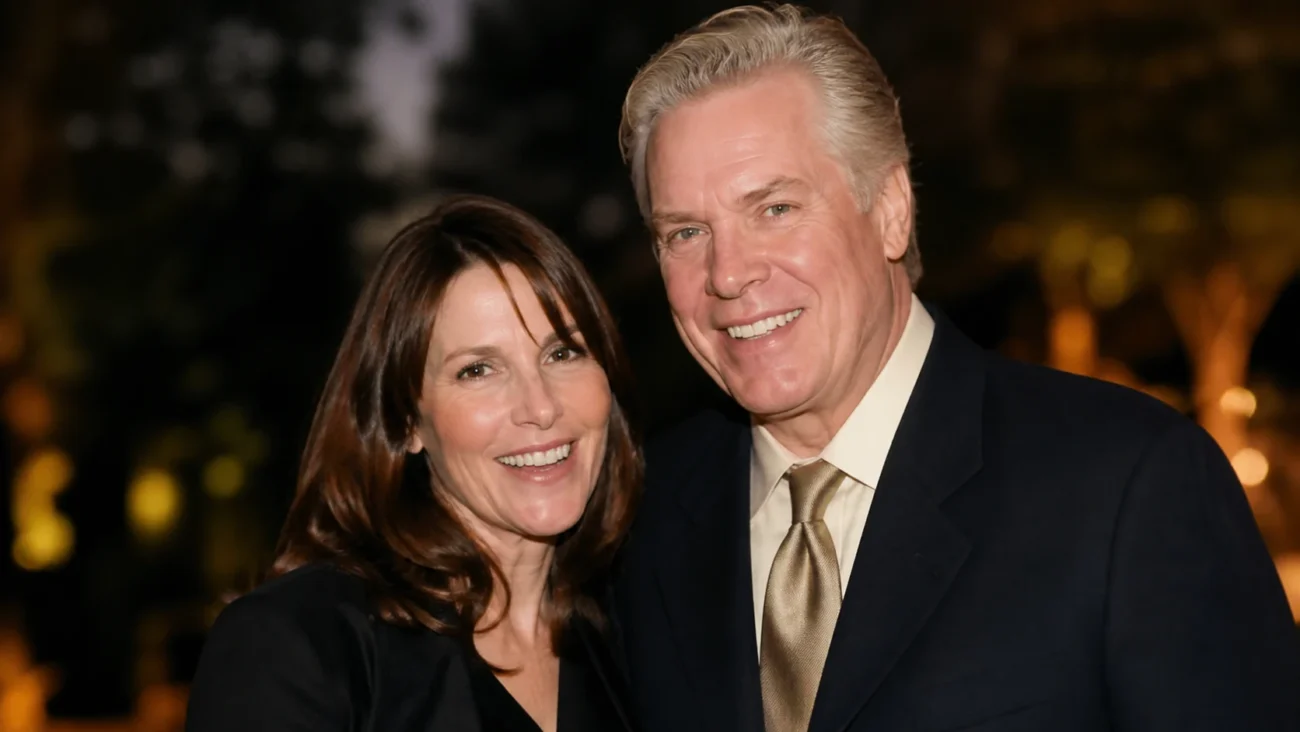
Lupe Gidley is best known to many readers through her long marriage to actor Christopher McDonald, the sharp, silver-haired performer who became a pop-culture fixture as Shooter McGavin in Happy Gilmore. But reducing her to “Christopher McDonald’s wife” misses the shape of her own story. Before she became part of a durable Hollywood family, Gidley worked as a performer in commercials, theater, music videos, and screen projects under more than one professional name. Her public record is modest, but it is real, and it tells the story of a woman who moved through entertainment without turning herself into a permanent public spectacle.
The reason people search for Lupe Gidley is usually simple. They see her name attached to McDonald, notice that the couple has been together for decades, and want to know who she is beyond a red-carpet caption. Search results can make that harder than it should be, because her credits appear under Lupe Gidley, Lupe McDonald, and, in one early case, the stage name Meg James. Add in the usual celebrity-biography recycling, and a fairly clear life becomes clouded by unsupported dates, guessed finances, and repeated claims that deserve more care.
The most accurate portrait of Gidley is not a tale of hidden fame. It is a biography of a working performer who had a foot in Hollywood, theater, advertising, and family life, then chose a lower-profile path than many people around her. That choice gives her story a different kind of interest. She belongs to the world of entertainment, but she has never seemed determined to be consumed by it.
Early Life and Publicly Known Background
Lupe Gidley’s early life has not been documented in the same depth as the early lives of actors who spent decades giving interviews. Public sources do not provide a fully verified childhood timeline, confirmed hometown, or detailed account of her parents and upbringing. Some online profiles give exact personal details, but many of those claims are repeated without clear sourcing. A careful biography has to begin by saying plainly that much of Gidley’s private background remains private.
What can be said with more confidence is that Gidley was educated, artistically inclined, and already pursuing performance work as a young adult. In a later interview connected to Billy Joel’s “We Didn’t Start the Fire” video, she recalled being fresh out of college when she appeared in the project. She was living in Santa Monica at the time, placing her in the orbit of Southern California entertainment work during the late 1980s. That detail helps explain how her early career moved through commercials, casting calls, music videos, and theater rather than through one clean movie-star path.
The name itself has created confusion. She is widely known as Lupe Gidley, but several entertainment credits use Lupe McDonald, her married name. She also said she used Meg James as a stage name for the Billy Joel video, which made her harder to trace years later. For readers trying to follow her record, those name changes matter because they explain why one person can appear scattered across different databases and recollections.
First Work in Commercials and Performance
Before her name was tied to a famous actor, Gidley was already working. She described doing commercials for major brands including McDonald’s, Miller Lite, Pepsi, and Honeywell. Those jobs may not carry the prestige of starring roles, but they were meaningful parts of the entertainment economy. Commercial work demanded camera comfort, timing, professional reliability, and the ability to make a quick impression.
That kind of early résumé was common for young performers in Los Angeles during the 1980s. A national commercial could pay well, build contacts, and lead to more auditions, even if it did not make someone famous by name. Gidley’s path appears to have fit that world: steady professional work, recognizable projects, and enough momentum to move between formats. She was not a celebrity yet, but she was not a bystander either.
Her early work also shows why her later public image can feel hard to classify. She was not simply a model, not only an actress, and not a celebrity spouse who entered the public eye through marriage alone. She worked in the spaces where acting, advertising, and popular culture overlapped. That background gives her biography more texture than the short summaries often attached to her name.
The Billy Joel Video That Keeps Her Searchable
One of the strongest confirmed points in Gidley’s career is her appearance in Billy Joel’s 1989 music video for “We Didn’t Start the Fire.” The song was one of Joel’s most famous late-career hits, built around a rapid-fire list of historical and cultural references from the postwar era onward. Its video matched that concept with images that moved across decades of American memory. Gidley appeared in that production under the stage name Meg James.
Her recollection of the job is valuable because it places her inside a specific pop-culture moment. She remembered being 23 when she worked on the video and described herself as newly out of college, excited to be part of such a large, energetic production. She was not presented as the star of the video, and she did not describe the experience as a life-defining triumph. Instead, her account sounds like a working performer remembering a memorable early job that later became more famous than anyone on set may have expected.
That appearance remains important because it connects Gidley to a widely remembered piece of late-1980s pop culture. Music videos of that era could become cultural artifacts in their own right, especially when tied to artists as prominent as Billy Joel. For many performers, those clips became visible credits that outlived the original day of filming. Gidley’s role in the video is one of the reasons her name continues to surface in searches decades later.
Theater Work and Meeting Christopher McDonald
The turning point in Gidley’s public life came through theater, not through a Hollywood premiere. She met Christopher McDonald while both were working in New Mexico, with accounts placing their meeting around a production at New Mexico Repertory. Gidley later connected that period to Mark Medoff’s play When You Comin’ Back, Red Ryder?, in which McDonald was the leading man. The setting matters because it frames their relationship as one that began in craft, rehearsal, and stage work rather than in celebrity culture.
McDonald was already building a serious acting career by then. He had appeared in film and television, and by the early 1990s he was receiving wider attention for his role in Thelma & Louise. Gidley entered his life before his most quoted role, Shooter McGavin, turned him into a familiar figure for a generation of comedy fans. Their relationship was already established before the loudest phase of his fame.
The couple married in 1992, according to widely cited public accounts. Their marriage has lasted through decades of industry change, career surges, family life, and renewed attention around McDonald’s best-known roles. In Hollywood, where short relationships often receive more coverage than lasting ones, that longevity is part of why readers remain curious. Gidley’s presence beside McDonald has become one of the quieter constants in his public story.
Marriage to Christopher McDonald
Christopher McDonald’s career has made the marriage more visible than Gidley herself has chosen to be. He is a veteran character actor with a long list of film and television roles, including Thelma & Louise, Quiz Show, Requiem for a Dream, Happy Gilmore, The Iron Giant, Boardwalk Empire, and Hacks. His performances often carry a polished arrogance, a comic bite, or a villainous charm. Offscreen, public references to his family have often presented Gidley as a grounding presence.
The couple’s marriage has been described in public sources as beginning in 1992, and they are known to have four children. Their children are commonly identified as Jackson Riley, Hannah Elizabeth, Rose, and Ava Catherine. McDonald has spoken in faith-based and personal interviews about family life, parenting, and raising children with a sense of gratitude and religious grounding. Those comments offer rare windows into the household, though they come through McDonald’s voice rather than Gidley’s.
Gidley has appeared with McDonald at public events over the years, including industry ceremonies, premieres, and award-season gatherings. Those appearances show that she has participated in the public side of his career without seeming to chase a separate celebrity identity. She is visible enough to be known, but private enough that much of her daily life remains outside public view. That balance is one of the defining facts of her adult life.
Children and Family Life
Lupe Gidley and Christopher McDonald’s family life is one of the most searched parts of her biography. The couple has four children, and their family has been mentioned in reference profiles and interviews about McDonald. Their eldest son is often listed as Jackson Riley, and the daughters are commonly listed as Hannah Elizabeth, Rose, and Ava Catherine. Because the children are not all public figures in the same way their father is, responsible coverage should avoid treating their private lives as open material.
McDonald has described fatherhood as a central part of his identity. In public comments, he has spoken about prayer, gratitude, and the effort to stay connected to family despite the travel and irregular schedule that acting demands. Those statements suggest that Gidley’s home life was not a side note to the family’s public story. She appears to have been a steady presence in the family while McDonald’s work took him across film sets, television productions, and promotional events.
The family’s long-running privacy also says something about Gidley’s priorities. She has not built a brand around motherhood, marriage, or life beside a famous actor. There are no widely established memoirs, lifestyle platforms, or constant interview cycles attached to her name. In a culture that often rewards overexposure, her public restraint feels intentional even when it is not formally explained.
Acting Credits as Lupe McDonald
Gidley’s screen credits are limited but traceable. Under the name Lupe McDonald, she is associated with projects including Daft Punk: The Prime Time of Your Life, Money Shot, and Klarinet Klub. These are not the credits of a mainstream star, but they confirm that her connection to performance continued beyond her early commercial and music-video work. They also show how her married name became part of her professional record.
The Daft Punk video The Prime Time of Your Life is a striking entry because it belongs to a very different cultural moment from Billy Joel’s 1989 video. Released in the 2000s, it is remembered as an unsettling visual piece tied to Daft Punk’s Human After All era. Gidley is usually listed in cast references as playing the mother. The role may be brief, but the project itself is distinct enough to remain searchable.
Her later credits in Money Shot and Klarinet Klub point toward smaller-scale screen work rather than a pursuit of mainstream celebrity. In Money Shot, she is credited in some listings as Carol the Secretary, while Klarinet Klub places her in another compact acting role. These projects suggest a performer who remained open to acting without making it the center of public identity. They also complicate the idea that she simply disappeared after marriage.
Public Image and Red-Carpet Appearances
Gidley’s public image has formed mostly through association, appearance, and omission. She has appeared beside Christopher McDonald at selected public events, often photographed as his wife rather than interviewed as an independent celebrity. That kind of visibility is common for spouses of actors, but her case is unusual because she had her own performance background before the marriage. The result is a public image that is present but lightly sketched.
Photographs over the years place Gidley at industry events ranging from award-related gatherings to film premieres. These appearances show a woman comfortable enough in entertainment spaces to attend them, yet not eager to turn them into a personal publicity campaign. She does not appear to have pursued the influencer-style celebrity economy that later became common for people adjacent to Hollywood. Her public image is more old-fashioned: family, occasional appearances, and a record of work rather than constant self-promotion.
That restraint may be one reason search interest around her can feel persistent. Readers notice a long marriage, a recognizable face in old and new event photos, and a handful of interesting credits, then discover that there is not much direct commentary from Gidley herself. The lack of oversharing creates curiosity. It also places more responsibility on writers to avoid filling the silence with speculation.
Net Worth and Income Sources
There is no reliable public accounting of Lupe Gidley’s personal net worth. Some online biography sites attach estimates to her name, but those figures are usually unsourced and should not be treated as verified financial information. Her likely income sources over time would have included commercial work, acting jobs, and possibly other private or family financial arrangements. But without filings, direct statements, or credible financial reporting, any exact number would be guesswork.
Christopher McDonald’s acting career is far more documented, and public estimates of his wealth also vary by outlet. Those estimates often mix confirmed career facts with assumptions about salary, residuals, real estate, investments, and family assets. Gidley’s finances are sometimes folded into those broader celebrity-spouse estimates, which can make the numbers look more precise than they are. A responsible profile should resist presenting a neat figure simply because readers search for one.
What can be said is that Gidley has been connected to entertainment work across several decades and to a family supported in part by McDonald’s long acting career. Commercial work in her early years could have been financially useful, especially if national campaigns were involved. Later credits may have added income, but they do not provide enough public information for a serious estimate. The truthful answer is that her net worth is not publicly confirmed.
Confusion, Rumor, and Common Mistakes
The most common mistake in writing about Lupe Gidley is treating repeated online claims as verified facts. Several pages give exact birth dates, full names, parent names, and net-worth figures without showing strong sourcing. Some claims appear to have been copied from unrelated profiles or mixed with facts about Christopher McDonald’s family. Once an error appears on enough websites, it can begin to look true even when it rests on nothing solid.
Another point of confusion involves Pamela Gidley, the late actress known for Twin Peaks: Fire Walk with Me. The shared surname leads some searchers to wonder whether Lupe Gidley and Pamela Gidley were related. No reliable public source establishes such a relationship. They should be treated as separate people unless stronger evidence says otherwise.
There is also confusion around her professional names. Lupe Gidley is the name most readers search, Lupe McDonald appears in screen and music-related references, and Meg James was used as a stage name in at least one early video credit. That does not mean there are three different people. It means Gidley’s public record has to be read across names, years, and credit systems.
Where Lupe Gidley Is Now
Lupe Gidley appears to live a largely private life now. Public references in recent years have mostly come through her connection to Christopher McDonald, event appearances, and renewed interest in his work. McDonald’s role in Hacks and the return of Happy Gilmore attention have brought him back into entertainment news cycles, which naturally pulls curiosity toward his family. Gidley, however, has not used that attention to launch a major public comeback.
Her last widely searchable acting credits are not recent enough to suggest an active high-profile screen career. That does not mean she is inactive in every sense, only that her current work and daily life are not heavily documented. The best available reading is that she remains a private figure with past entertainment credits and a long-standing place in McDonald’s personal story. For many readers, that answer may feel less dramatic than expected, but it is more honest.
The modern celebrity world often makes privacy look like absence. In Gidley’s case, it may be better understood as a consistent choice. She has been close to fame for decades, but she has not treated fame as an obligation. That makes her a quieter figure, not a lesser one.
Why Lupe Gidley Still Interests Readers
Gidley’s appeal as a search subject comes from contrast. She is connected to a famous actor, appeared in memorable entertainment projects, and has attended public events, yet she remains lightly documented. That combination invites curiosity because it leaves readers with real facts but not full access. People want to know whether there is a larger story behind the name.
There is also something culturally revealing about her biography. Not everyone who works in entertainment becomes a brand, and not everyone married to a public figure chooses to become one too. Gidley’s life sits at the intersection of performance, marriage, motherhood, and privacy. That makes her story relatable in a way that louder celebrity profiles are not.
Her biography also reminds readers that small credits can carry long lives. A commercial, a music video, a theater production, or a short film may seem minor at the time, but those projects become part of the public record. In Gidley’s case, they form a trail that reaches from 1980s pop music to 2000s electronic culture and long-running Hollywood family life. That is a quieter kind of cultural presence, but it still matters.
Frequently Asked Questions
Who is Lupe Gidley?
Lupe Gidley is an actress and former commercial performer also known professionally as Lupe McDonald. She is widely recognized as the wife of actor Christopher McDonald, but she had her own entertainment background before and after their marriage. Her known work includes commercials, theater, Billy Joel’s “We Didn’t Start the Fire” video, and several later screen credits.
Is Lupe Gidley married to Christopher McDonald?
Yes, Lupe Gidley is married to Christopher McDonald. Public sources widely place their marriage in 1992, after the couple met through theater work in New Mexico. Their marriage has lasted for decades, making it one of the steadier long-term relationships connected to a recognizable Hollywood actor.
How many children does Lupe Gidley have?
Lupe Gidley and Christopher McDonald have four children. Their children are commonly identified as Jackson Riley, Hannah Elizabeth, Rose, and Ava Catherine. Because the children have varying degrees of public visibility, details about their private lives should be treated with care.
Was Lupe Gidley in a Billy Joel video?
Yes, Lupe Gidley appeared in Billy Joel’s 1989 music video for “We Didn’t Start the Fire.” She has said she used the stage name Meg James for that project, which later made her harder to identify. The video remains one of her most interesting early public credits.
What acting credits does Lupe Gidley have?
Lupe Gidley’s known screen credits are often listed under Lupe McDonald. They include Daft Punk: The Prime Time of Your Life, Money Shot, and Klarinet Klub. Her résumé is not large, but it confirms that she continued to appear in performance projects beyond her early commercial and theater work.
What is Lupe Gidley’s net worth?
Lupe Gidley’s personal net worth has not been reliably confirmed. Online estimates exist, but most do not provide clear sourcing and should be read as guesses rather than verified financial facts. Her income likely came from commercial work, acting roles, and private family finances, but no exact public figure can be stated with confidence.
Is Lupe Gidley still acting?
There is no strong public evidence that Lupe Gidley is currently acting in a regular, high-profile way. Her later listed credits show that she did continue to take screen roles at different points, but she appears to have kept a private life in recent years. The most accurate answer is that she has acted, but she is not currently known as an active public-facing performer.
Conclusion
Lupe Gidley’s biography is not a story of constant fame, and that is part of what makes it worth telling carefully. She worked in entertainment, appeared in a famous Billy Joel video, acted under more than one name, and became part of a long Hollywood marriage. Her public trail is smaller than many celebrity profiles suggest, but it is not empty.
The truth is, Gidley represents a kind of entertainment life that often gets flattened online. She was close to major cultural moments without becoming the headline. She built a family with an actor whose roles became widely recognized, yet she did not turn that proximity into a public persona of her own. That balance is rare enough to make her stand out.
A fair profile of Lupe Gidley has to leave room for privacy. Not every missing detail is a mystery, and not every unsourced claim deserves to be repeated. What remains is a warm, specific portrait of a performer, wife, mother, and private figure who has stayed connected to Hollywood while keeping much of her own life offstage.
Her place in public memory may always be tied to Christopher McDonald, but it does not belong only to him. It also belongs to the young performer in commercials, the woman in a Billy Joel video, the actress with later screen credits, and the person who chose a quieter life after touching several corners of popular culture. That is enough for a real biography, and it is more meaningful than a louder version built on guesses.
