
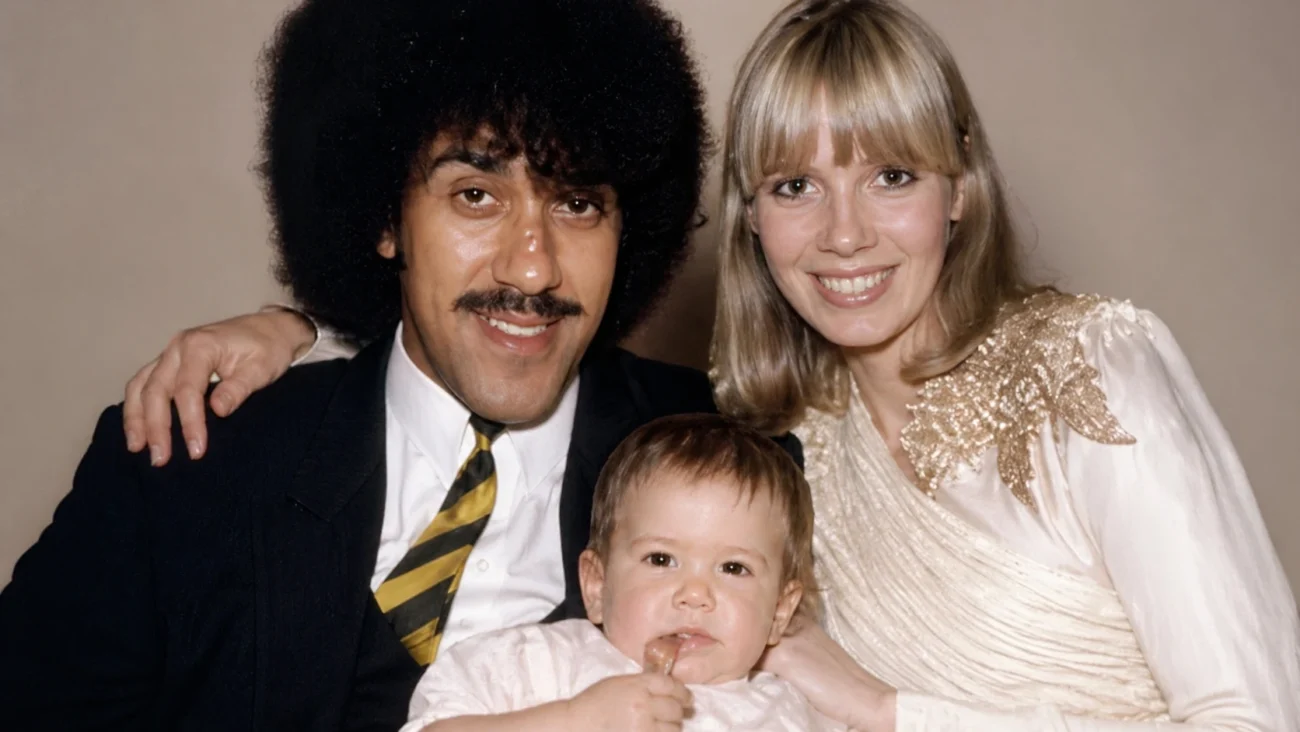
Caroline Crowther is best known as the former wife of Phil Lynott, the magnetic singer, bassist, and songwriter who led Thin Lizzy and became one of Ireland’s most beloved rock figures. Her name appears again and again in searches about Lynott because she stood close to him during some of the most intense years of his public life, and because their two daughters, Sarah and Cathleen, remain part of the emotional story fans attach to his music. Yet Caroline herself has never lived like a celebrity chasing attention. Her biography is really the story of a woman connected to fame from childhood, drawn into the orbit of a rock icon, and then left to carry a family history that the public still revisits decades later.
That makes writing about Caroline Crowther different from writing about a performer with a long list of public credits. The verified facts are meaningful, but they are not endless. She was born into a British entertainment family, married Lynott on Valentine’s Day in 1980, became the mother of his daughters, and later appeared in public settings linked to his legacy. Beyond that, much of her life has stayed private, and a fair account has to respect that line while still explaining why readers remain interested.
Early Life and Family Background
Caroline Crowther grew up with a familiar name in British entertainment because her father was Leslie Crowther, the actor, comedian, television presenter, and charity campaigner. Leslie became known to generations of British viewers through children’s television, light entertainment, game shows, stage work, and public appearances. He married Jean Stone in 1954, and the couple had a large family that included Caroline. That background meant Caroline was not completely outside public life even before she became associated with Phil Lynott.
Leslie Crowther’s public image was warm, energetic, and dependable, built across decades when television presenters became almost household companions. He worked in a very different world from the rock scene that later surrounded his daughter, but both worlds carried their own pressures. Entertainment families often live with a strange mix of privilege and exposure, where the public knows the name but not the private person. Caroline’s later reluctance to make herself a public personality makes more sense when seen against that early closeness to fame.
Reliable public details about Caroline’s childhood, schooling, and early ambitions are limited. That absence should not be filled with guesswork, even though many readers naturally want a fuller early-life portrait. What can be said is that she came from a family familiar with performance, press attention, and public curiosity. Her later life would connect that family background with one of the most compelling figures in Irish rock.
Meeting Phil Lynott and Entering the Thin Lizzy World
Phil Lynott was already a major figure by the time Caroline Crowther became part of his life. Born in 1949 in West Bromwich and raised largely in Dublin, Lynott had become the face and poetic center of Thin Lizzy. He was tall, striking, witty, and charismatic, with a stage presence that made him seem larger than the room. Songs such as “The Boys Are Back in Town,” “Dancing in the Moonlight,” and “Still in Love with You” helped turn him into a rock star with unusual emotional range.
Caroline entered a world that looked glamorous from outside but was demanding at close range. Thin Lizzy’s success meant touring, recording, interviews, fans, and constant movement. Lynott’s charm was real, but so were the pressures around him, including drug use and the instability that often followed rock fame in the 1970s and early 1980s. For anyone close to him, the public myth and the private reality were never the same thing.
Their relationship became part of Lynott’s more personal story because it connected the hard-living rock figure to domestic life. He was not only a frontman in black leather with a bass guitar; he was also a husband and father whose gentler side appeared in songs written for his children. Caroline’s place in that story has often been viewed through Lynott’s fame, but she was not simply a footnote. She was part of the family life that shaped some of his most tender work.
Marriage to Phil Lynott
Caroline Crowther married Phil Lynott on 14 February 1980. The date has often been repeated because it was Valentine’s Day, a detail that fits the romantic image fans like to attach to Lynott. Their marriage came after Thin Lizzy had already reached international recognition, and Lynott was living with the benefits and burdens of success. For Caroline, marriage meant joining not just one man’s life but the restless machinery around a famous band.
The couple had two daughters, Sarah and Cathleen. Sarah Lynott was born before the marriage, and Cathleen followed after Caroline and Phil became husband and wife. Both daughters became important to Lynott’s emotional world and to the public memory of him. His songs for them helped soften the image of a musician often remembered through touring, addiction, and rock excess.
The marriage itself did not last. Public biographical records state that Caroline and Phil separated in May 1984, less than two years before his death. The separation came during a difficult period marked by Lynott’s worsening drug use, drinking, and personal unhappiness. It would be unfair to reduce the marriage to those struggles, but it would also be false to pretend they were not central to the period.
Motherhood and the Songs Sarah and Cathleen Inspired
For many fans, Caroline Crowther’s most enduring public connection to Phil Lynott is through their daughters. Sarah and Cathleen were not just family members hidden behind the scenes; they became part of Lynott’s songwriting legacy. “Sarah,” released by Thin Lizzy in 1979, is one of his best-known love songs to his daughter. “Cathleen,” though less widely known to casual listeners, belongs to the same deeply personal side of his catalogue.
These songs matter because they reveal a version of Lynott that complicates the usual rock-star story. He could write about gangs, boys on the town, romance, danger, and exile, but he could also write with open tenderness about fatherhood. That emotional range is one reason his work has lasted. Caroline’s family life with him gave shape to that part of the legacy, even when she herself stayed outside the spotlight.
Motherhood also placed Caroline in a painful position after Lynott’s decline and early death. She had to raise children whose father was both a real person and a growing cultural legend. That kind of legacy can be beautiful, but it can also be heavy. Public affection for Lynott did not erase the private work of helping children understand and live with the loss of a father.
Separation, Loss, and the End of Lynott’s Life
By the mid-1980s, Phil Lynott’s life had become increasingly troubled. Thin Lizzy had split, and his solo career and later projects did not bring the same stability or success. His health and personal life were damaged by addiction, and those close to him saw the effects more clearly than most fans could. Caroline and Phil had already separated before the final crisis of his life.
Lynott died on 4 January 1986 at the age of 36. His death shocked fans but did not come from nowhere; it followed years of drug use and physical decline. For the public, the loss became part of rock history, another gifted artist gone too young. For Caroline and her daughters, it was a family tragedy before it was a cultural event.
After his death, Lynott’s reputation continued to grow rather than fade. Memorials, documentaries, reissues, tributes, and fan pilgrimages kept his name alive. Caroline’s name appeared whenever writers revisited his marriage, children, and final years. Yet she did not turn that connection into a constant public role, which is one reason curiosity about her has remained so persistent.
Life After Phil Lynott
Caroline Crowther’s life after Phil Lynott has been largely private. That privacy is one of the most important facts about her, because it shapes what can and cannot responsibly be said. She did not become a regular media commentator, publish a major memoir, or build a career on her marriage to Lynott. Instead, she appears only occasionally in the public record, usually in connection with family events or commemorations.
Some references identify her later as Caroline Taraskevics, a name used in public captions and reports around Thin Lizzy-related events. This suggests a later married or family name, though the details of that private life are not widely documented in reliable public sources. A careful biography should not turn that into speculation about her relationships or present household. The public record shows her continuing link to Lynott’s legacy without giving readers a full map of her private life.
What’s striking is how much interest remains despite that silence. Fans still search for her because Lynott’s story feels unfinished, and families often become the places where readers look for emotional closure. But Caroline’s decision not to live publicly may be the clearest statement available. She has allowed the legacy to be honored without making herself its constant narrator.
Public Appearances and the Lynott Legacy
Although Caroline Crowther has stayed mostly private, she has appeared in public settings connected with Phil Lynott’s memory. She has been associated with screenings and discussions around the documentary “Phil Lynott: Songs for While I’m Away,” which examined Lynott’s life through interviews, music, and archival material. Such appearances show that she has not been absent from the story. They also show that her role is measured rather than performative.
In 2019, she appeared with Sarah and Cathleen during events connected to Thin Lizzy commemorative stamps issued by An Post for the band’s 50th anniversary. That public moment was meaningful because it placed Lynott’s family at the center of an official tribute. It also showed how his legacy had moved from rock venues and record sleeves into national cultural memory. Caroline stood there not as a celebrity spouse, but as part of the family that survived the myth.
These appearances are rare enough to matter. They suggest a woman willing to honor the father of her children while still preserving her own boundaries. That balance is not always easy in the world of rock legacy, where fans often want access to every private detail. Caroline’s public image has stayed defined by restraint, dignity, and a refusal to become a character in someone else’s drama.
Career, Work, and Public Identity
Unlike her father Leslie Crowther or her former husband Phil Lynott, Caroline Crowther does not have a widely documented public career in entertainment. Some online accounts describe her in broad terms, but reliable sources do not provide a detailed professional timeline. That means any claim about a major career, business venture, or long public résumé should be treated carefully unless backed by clear evidence. Her public identity remains tied mainly to family history, not to a career she promoted in the media.
This does not mean she lacked work, ambition, or a full adult life. It only means those details have not been made public in a verifiable way. Many people connected to famous figures choose careers and relationships outside the media record, and Caroline appears to be one of them. A respectful biography should not confuse lack of public documentation with lack of substance.
Her father and former husband were both performers, but Caroline’s own public presence has been quieter. That contrast has shaped how readers see her. She is often described through the men around her, yet the more interesting fact may be that she did not try to compete with their fame. She stepped back, protected her privacy, and let the public record remain limited.
Money, Income Sources, and Net Worth Claims
Search interest around Caroline Crowther often includes questions about net worth. The honest answer is that there is no reliable public estimate of her personal net worth. Websites that assign a precise figure without records, filings, inheritance documentation, or credible financial reporting should not be treated as trustworthy. In her case, a number would be more likely to mislead than inform.
Her connection to Phil Lynott naturally raises questions about royalties, estate matters, and family inheritance. Lynott’s music has continued to generate cultural and commercial value through recordings, licensing, reissues, documentaries, and performances. But the details of his estate, royalty arrangements, and any private financial settlements involving Caroline are not fully public. Without verified documents, no serious writer should claim to know the numbers.
What can be said is broader and safer. Caroline’s public connection to Lynott carries cultural value, but cultural value is not the same as personal wealth. She has not built a visible business around that connection, and she does not appear to trade heavily on it. For readers, the most accurate answer is that her net worth is private and that published estimates should be viewed with caution.
Public Image and Media Portrayal
Caroline Crowther’s public image is unusually restrained for someone attached to such a famous rock biography. She is often described as Phil Lynott’s former wife, the mother of Sarah and Cathleen, and the daughter of Leslie Crowther. Those labels are accurate, but they are also incomplete. They explain why people know her name, not who she is in full.
The media has generally treated her less as a personality than as part of Lynott’s family story. That has protected her in some ways and flattened her in others. She is invoked whenever writers need to explain Lynott’s marriage or fatherhood, but she is rarely given the space of a full subject. The lack of public interviews means readers see her mostly through fragments.
That said, the fragments form a consistent impression. Caroline has not courted scandal, fed gossip, or made a spectacle of private grief. Her appearances around Lynott’s legacy have been calm and family-centered. In a culture that often rewards oversharing, that restraint has become part of how she is understood.
Leslie Crowther’s Influence and Family Context
Caroline’s father, Leslie Crowther, deserves attention because his career shaped the family background from which she came. He was a familiar British television figure whose work ranged from comedy and presenting to charity events. He became especially associated with light entertainment, including popular shows that made him recognizable to a broad public. His career belonged to an era when television personalities were treated almost like extended members of the family by viewers.
Leslie’s later life also carried hardship. He suffered serious injuries in a 1992 car crash and died in 1996. His obituary notices remembered him as a versatile entertainer and a committed charity worker. For Caroline, this meant both sides of fame were close to home: warmth, recognition, professional success, accident, illness, and public mourning.
That background gives Caroline’s life a larger frame. She was not simply a woman who married a rock star. She belonged to a family already touched by the opportunities and costs of public recognition. Her later privacy may reflect not shyness alone, but experience with what fame can take from family life.
Where Caroline Crowther Is Now
Current verified information about Caroline Crowther is limited. She appears to live privately and does not maintain a major public media profile. Reports and event captions from recent years show her appearing in connection with Lynott family tributes, but not as a regular public figure. That is the clearest available picture: present enough to honor the legacy, private enough to keep her own life protected.
This privacy has led to many search-driven questions, including whether she remarried, where she lives, and what she does now. Some sources use the name Caroline Taraskevics, but detailed personal information is not widely confirmed in reliable reporting. Without public confirmation, those areas should remain described as private. Curiosity is understandable, but it does not override the need for accuracy.
What remains public is her role in a family story that still matters to music fans. Through Sarah and Cathleen, Lynott’s personal legacy continues beyond the records. Through occasional public appearances, Caroline has helped mark that legacy without making herself its center. Her current status is best understood as private, family-connected, and largely outside the machinery of celebrity.
Why Caroline Crowther Still Matters
Caroline Crowther matters because she connects several strands of British and Irish popular culture. Through her father, she is linked to postwar British television and light entertainment. Through Phil Lynott, she is linked to Irish rock, diaspora identity, and one of the most charismatic songwriters of his generation. Through her daughters, she is linked to the intimate songs that keep Lynott’s softer side alive for listeners.
Her story also asks readers to think differently about the people near fame. Biographies often focus on the star at the center, while spouses and children become supporting details. But those people absorb the real consequences of public lives, from travel and pressure to addiction, grief, and memorialization. Caroline’s biography is limited in public facts, yet it reveals a great deal about the private costs around a public legend.
There is also value in what her story refuses to provide. It does not offer a neat redemption arc, a tell-all confession, or a monetized brand built from grief. It offers something quieter: a woman whose life intersected with fame but did not become consumed by it. That may be less dramatic, but it is more human.
Frequently Asked Questions
Who is Caroline Crowther?
Caroline Crowther is best known as the former wife of Phil Lynott, the lead singer, bassist, and songwriter of Thin Lizzy. She is also the daughter of British entertainer Leslie Crowther. Her public profile comes mainly from her connection to Lynott, their daughters Sarah and Cathleen, and occasional appearances tied to Lynott’s legacy.
When did Caroline Crowther marry Phil Lynott?
Caroline Crowther married Phil Lynott on 14 February 1980. The Valentine’s Day wedding has often been mentioned in accounts of Lynott’s life because it fits the romantic public image many fans associate with him. Their marriage took place during a major period in Lynott’s career, after Thin Lizzy had already become internationally known.
Did Caroline Crowther and Phil Lynott have children?
Yes, Caroline Crowther and Phil Lynott had two daughters, Sarah and Cathleen. Both daughters inspired songs by Lynott, which helped make his family life part of his musical legacy. Sarah and Cathleen have also appeared at public events honoring their father, including commemorations connected with Thin Lizzy.
Are Caroline Crowther and Phil Lynott still married?
No, Caroline Crowther and Phil Lynott separated in 1984. Lynott died on 4 January 1986 at the age of 36, after years of health and addiction struggles. Although their marriage had ended before his death, Caroline remains part of the family history that surrounds his life and work.
What is Caroline Crowther’s net worth?
There is no reliable public figure for Caroline Crowther’s net worth. Online estimates that give exact numbers should be treated carefully because they are usually not supported by financial records or credible reporting. Details about royalties, inheritance, and private finances connected to Phil Lynott’s estate are not public enough to support a firm estimate.
Where is Caroline Crowther now?
Caroline Crowther appears to live a private life and does not maintain a regular public profile. She has appeared in some public settings connected with Phil Lynott’s legacy, including family events and documentary-related occasions. Beyond that, her current personal life is not widely documented in reliable sources.
Is Caroline Crowther the same person as Professor Caroline Anne Crowther?
No, the name can refer to two different public figures. The Caroline Crowther discussed in connection with Phil Lynott is his former wife and the daughter of Leslie Crowther. Professor Caroline Anne Crowther is a maternal and perinatal health researcher associated with the University of Auckland, and she should not be confused with Lynott’s former wife.
Conclusion
Caroline Crowther’s life sits close to fame but not inside the usual celebrity script. She grew up in an entertainment family, married one of rock’s most memorable figures, became the mother of two daughters whose names live in his songs, and then chose a life that remained mostly private. That privacy has left gaps, but it has also preserved her dignity in a story often told through noise, loss, and legend.
The public knows Caroline mainly through relationships, and that is both true and incomplete. She was Leslie Crowther’s daughter, Phil Lynott’s wife, and Sarah and Cathleen’s mother. Yet the pattern of her life suggests someone who understood fame well enough not to mistake attention for meaning. Her choices after Lynott’s death show a woman who honored a legacy without surrendering herself to it.
What remains is a quieter biography than many readers expect, but a more respectful one. Caroline Crowther matters because she stood at the human center of a famous story, where love, music, family, addiction, grief, and memory all met. The best way to understand her is not to demand every private detail, but to recognize the part she played in a legacy that still moves people decades later.
