
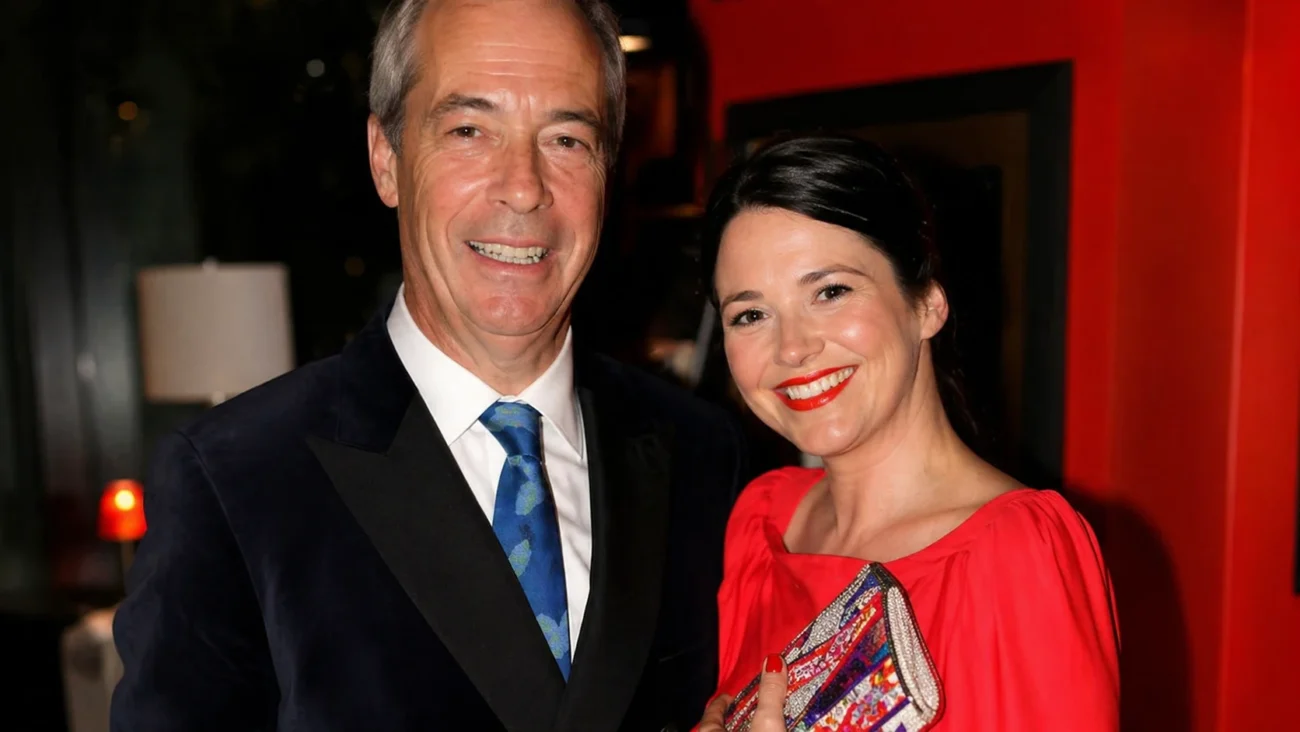
Gráinne Hayes is known to most people through one chapter of another person’s story. She was the first wife of Nigel Farage, the British politician who became one of the best-known figures in the campaign for Brexit and later the leader of Reform UK. Before that public life took shape, Hayes was part of Farage’s early adulthood, meeting him after a serious road accident in the 1980s and later building a family with him.
Her name attracts curiosity because it sits at the edge of a very public political career. Readers often want to know who she is, where she came from, whether she had children, and what happened after the marriage ended. The answer is more modest than many online profiles suggest. Hayes appears to have lived a private life, and the public record supports only a limited set of facts.
That does not make her story unimportant. It makes it a story that has to be handled carefully. Gráinne Hayes is not a campaign figure, public commentator, or celebrity spouse who has chosen the spotlight. She is a private person whose name became searchable because of her connection to one of Britain’s most recognizable political personalities.
Who Is Gráinne Hayes?
Gráinne Hayes is most widely identified as an Irish nurse and the first wife of Nigel Farage. Public accounts say she met Farage after he was badly injured in a road accident in Orpington in 1985. Hayes was involved in his care during his recovery, and their relationship later became a marriage.
The couple are commonly reported to have married in 1988. Their marriage lasted through Farage’s early career years, before he became a major national figure. It ended in divorce in 1997, by which time Farage’s political life was beginning to take clearer shape. They had two sons together, Samuel and Thomas.
Hayes herself has not built a public career around that connection. There are no well-established interviews, memoirs, campaign appearances, or public statements that define her in her own words. For that reason, any biography of her has to separate what is known from what is merely repeated. The responsible portrait is one of a woman linked to a public figure, but not absorbed into his public identity.
Early Life and Irish Background
Gráinne Hayes is often described as Irish, but detailed public information about her early life is scarce. Her exact date of birth, hometown, parents, siblings, schools, and childhood interests are not reliably documented in major public sources. That absence is not unusual for someone who did not seek fame before marriage. It simply means the early chapters of her life remain private.
The spelling of her first name, Gráinne, points to an Irish cultural background. It is a traditional Irish name with deep roots, often associated with Irish legend and history. Still, a name alone cannot support broad claims about upbringing, family values, education, or identity. Those details would require direct sourcing that is not available in the public record.
What can be said with confidence is that Hayes trained or worked as a nurse before becoming publicly associated with Farage. Nursing would have placed her in a demanding profession built on long hours, practical skill, and direct human care. But here too, the line matters. Her profession is known; the full course of her working life is not.
Work as a Nurse
Hayes’s professional identity enters the public record through the account of Farage’s 1985 accident. Farage, then a young commodities trader, was seriously injured after being hit by a car in Orpington. Reports have described severe injuries, a long recovery, and fears at the time that he might lose a leg. Hayes is identified in that story as the nurse who cared for him.
That meeting has often been retold in a romantic frame, but the plain facts are enough. A young man suffered a serious accident, a nurse helped care for him, and the two later married. The story has the shape of a dramatic beginning, but Hayes did not later turn it into a public narrative. She did not become a regular media voice about Farage’s private life or political rise.
There is little reliable information about where Hayes worked after that period. Some online accounts imply a fuller nursing career, but many do not show clear evidence. A careful biography should not turn one confirmed role into an invented résumé. What is known is that she was a nurse at the time her life intersected with Farage’s.
Meeting Nigel Farage
The accident that brought Hayes and Farage together happened before Farage became a household name. In 1985, he was working in the City of London, building a career in commodities trading. He was not yet the public face of Eurosceptic politics. His later political identity can make the earlier story seem more symbolic than it was at the time.
Farage’s injuries were serious enough to alter the course of his young adulthood. Public accounts have described a difficult recovery, and Hayes’s role as a nurse placed her near him during that vulnerable period. Relationships formed in hospitals can be intense, but the public record does not give enough detail to describe the private development of their bond. What is clear is that the connection survived beyond the ward.
By 1988, Hayes and Farage were married. Their marriage began before UKIP became a central vehicle for Farage’s politics and long before Brexit became a national referendum question. In that sense, Hayes belongs to the pre-fame part of his biography. She knew him before the image, the speeches, the television appearances, and the political storms.
Marriage and Family Life
Gráinne Hayes and Nigel Farage’s marriage lasted roughly nine years. They are reported to have had two sons, Samuel and Thomas. The family years coincided with a period of transition in Farage’s life, as he moved from finance toward politics. UKIP was founded in 1993, during the middle of the marriage, and Farage soon became one of its best-known figures.
There is little public detail about the day-to-day reality of the marriage. Hayes did not give a known public account of family life with Farage, and there is no strong record of her taking part in his political work. That makes it difficult to describe the marriage beyond its broad outline. The dates, children, and eventual divorce are known; the private texture is not.
The couple divorced in 1997. By then, Farage was already deeply involved in Eurosceptic politics, and his public career would soon expand further. Hayes did not follow him into that public world after the separation. Her name remained in biographical references, while her life appears to have continued outside the media frame.
Children and Family Privacy
Hayes and Farage’s two sons, Samuel and Thomas, are among the few family details regularly attached to her name. They were born during the marriage and are also part of Farage’s personal biography. Unlike their father, they have not maintained the same level of public visibility. That distinction deserves respect.
Children of political figures often become the subject of curiosity without choosing public life themselves. In this case, there is no reason to stretch beyond what is publicly known. Their names are reported, but their personal lives, careers, relationships, and views should not be treated as open material without strong evidence. Public interest has limits, especially around family members who are not public officials.
Hayes’s own privacy also protects the family’s privacy. She has not used her connection to Farage to promote a public platform or to tell a personal story in the press. That silence has left room for speculation, but speculation is not biography. The more honest approach is to acknowledge the family connection and stop where the evidence stops.
Divorce from Nigel Farage
The marriage between Gráinne Hayes and Nigel Farage ended in divorce in 1997. That date is widely reported, but the reasons for the split are not documented in a way that allows for a detailed public account. Some online profiles hint at strain or political ambition, but those claims are often thin. Without direct sourcing, they should not be presented as fact.
Divorce is often treated as a turning point in celebrity profiles, but Hayes was not living as a celebrity. She was the former wife of a man whose public life would become much larger after their marriage ended. The split placed her further outside the story that later defined Farage: European politics, UKIP leadership, Brexit, and Reform UK. Her public identity remained attached to him, even as her private life moved away from him.
Farage later remarried. His second marriage, to Kirsten Mehr, produced two daughters and also became part of press coverage around his personal life. Hayes, by contrast, remained largely absent from public reporting after her divorce. That contrast helps explain why information about her is limited and often repetitive.
Public Image and Media Attention
Gráinne Hayes has no major public image in the usual sense. She is not known through interviews, public appearances, television work, books, speeches, or social media. Her image is built almost entirely by third parties, usually in short biographical summaries of Nigel Farage. That makes the public version of her life unusually dependent on context.
The tone of writing about Hayes often says more about internet biography than about Hayes herself. Some articles describe her as mysterious, private, or hidden, but those words can create drama where there may be none. A person who does not speak to the press is not necessarily hiding. She may simply be living a life that does not require public explanation.
Respectful coverage should avoid turning privacy into a puzzle. Hayes’s connection to Farage makes her name searchable, but it does not make every detail of her life a matter of public interest. The strongest profile of her is therefore restrained. It tells readers what is known and does not pretend that absence is a secret waiting to be solved.
Relationship to Nigel Farage’s Political Rise
Hayes’s marriage to Farage came before his best-known political years. Farage became a Member of the European Parliament in 1999, two years after the divorce. He later led UKIP, became one of the loudest campaigners for Britain leaving the European Union, and founded the Brexit Party before it became Reform UK. In 2024, he won a seat in the UK Parliament as MP for Clacton.
That timeline matters because Hayes is sometimes pulled into Farage’s political story after the fact. She was present in his life before he reached his greatest public prominence, but there is no reliable evidence that she shaped his later political strategy or public positions. Marriage can influence a person’s life, of course. But influence is not the same as documented political involvement.
It is fair to say Hayes belonged to Farage’s formative adult years. It is not fair to cast her as a hidden figure behind Brexit or Reform UK without evidence. The public record does not support that claim. Her story intersects with Farage’s, but it should not be swallowed by his.
Money, Career, and Net Worth
There is no credible public estimate of Gráinne Hayes’s personal net worth. Websites that attach a figure to her name often do so without showing reliable sourcing. Because Hayes has not lived as a public business figure, entertainer, politician, or executive, there is little public financial data from which to build a responsible estimate. Any precise number should be treated with skepticism.
Her known income source was nursing, but the public record does not show her full career path. It is not clear how long she worked in the profession, whether she continued after marriage, or what work she may have done later. Without those details, claims about wealth or financial status are not just uncertain; they risk being invented. A serious biography should say that plainly.
Farage’s finances, media work, and political career have been reported separately, but they should not be folded into Hayes’s biography. Former spouses may share parts of a financial history, but that does not justify assigning one person’s assets or earning power to the other. Hayes’s personal money situation remains private. That is the most accurate answer.
Current Status and Where She Is Now
The most searched question about Gráinne Hayes is also the hardest to answer responsibly: where is she now? There is no solid recent public record confirming her current residence, occupation, relationship status, or day-to-day life. Many articles say she lives privately, but that is really a way of describing the lack of public information. It is not a verified biography of her present life.
What can be said is that Hayes has not maintained a visible media presence. She has not become a regular commentator on Farage, Brexit, British politics, or her former marriage. She has not appeared to seek attention from the public interest surrounding Farage’s career. That absence is consistent across the available record.
For readers, this may feel incomplete, but it is also the most honest version of the story. There are public figures whose lives can be tracked through interviews, filings, speeches, projects, and appearances. Hayes is not one of them. Her current status appears to be private, and no serious account should pretend otherwise.
Common Misunderstandings About Gráinne Hayes
One common misunderstanding is that Gráinne Hayes is a public political figure because she was married to Nigel Farage. She is not. The public record does not show her campaigning beside him, speaking for his causes, or holding a political role. Her connection is personal and historical, not public and professional.
Another confusion comes from the name itself. There are other people named Gráinne Hayes, including public professionals and academics, whose careers may appear in search results. Those records should not be merged with Farage’s former wife. Shared names are a frequent source of biographical errors, especially when one person has a limited public footprint.
A third mistake is to treat every unanswered question as evidence of mystery. Hayes’s early life, later career, and present circumstances are not widely documented, but that does not mean there is a hidden scandal or dramatic untold story. It means the information is private. Good biography does not fill every blank; it knows which blanks to leave alone.
Why Her Story Still Draws Interest
Hayes continues to draw interest because Farage continues to draw interest. His career has moved across finance, European Parliament politics, party leadership, broadcasting, Brexit campaigning, and Westminster. Every return to the headlines sends readers back through his life story. Former spouses often become part of that search, especially when they were present before fame.
There is also a human reason for the curiosity. The story of a nurse meeting a badly injured young man, marrying him, having children, and later watching his public life grow from a distance has an obvious narrative pull. It feels like the opening chapter of a larger biography. But in Hayes’s case, the later chapters are not public.
That is why her story remains both interesting and limited. She stands at the beginning of a public man’s adult life, but not at the center of his later public career. The distinction is easy to blur and important to keep. Readers deserve clarity rather than embroidered certainty.
Frequently Asked Questions
Who is Gráinne Hayes?
Gráinne Hayes is best known as the first wife of British politician Nigel Farage. Public accounts identify her as an Irish nurse who cared for Farage after his serious 1985 road accident in Orpington. She later married him and became part of his early family life before his most prominent political years.
She is not known as a public figure in her own right. Most information about her appears in profiles of Farage rather than in interviews or records centered on Hayes herself. That is why responsible accounts of her life are careful and limited.
Was Gráinne Hayes Nigel Farage’s nurse?
Yes, public reporting identifies Hayes as the nurse who cared for Farage after his 1985 accident. The accident happened before Farage became a national political figure, and it was serious enough to become a lasting part of his personal story. Hayes entered the public record because of her role during that recovery.
The relationship later became personal, and the two married in 1988 according to widely reported accounts. Details about exactly how the relationship developed are not publicly documented. Writers should avoid adding romantic detail that cannot be verified.
When did Gráinne Hayes marry Nigel Farage?
Gráinne Hayes and Nigel Farage are commonly reported to have married in 1988. Their marriage lasted until 1997, ending before Farage became a Member of the European Parliament. Those dates place the marriage in the early stage of Farage’s adult and political life.
During the marriage, Farage moved closer to organized Eurosceptic politics. UKIP was founded in 1993, while Hayes and Farage were still married. Even so, there is no strong evidence that Hayes had a public political role.
Did Gráinne Hayes and Nigel Farage have children?
Yes, Gráinne Hayes and Nigel Farage had two sons, Samuel and Thomas. Their names are reported in public accounts of Farage’s family life. They have not lived with the same level of public exposure as their father.
Because the sons are not major public figures, details about their personal lives should be treated with restraint. Their existence is relevant to Hayes’s biography, but their private choices are not automatically public material. A respectful account keeps that boundary clear.
What is Gráinne Hayes’s net worth?
There is no credible public figure for Gráinne Hayes’s net worth. Any article that gives an exact amount without clear sourcing should be treated with caution. Hayes has not had the kind of public financial career that would allow for a reliable estimate.
Her known profession was nursing, but the public record does not show her full work history. It is also not responsible to attach Nigel Farage’s reported income or assets to her. Her personal financial status remains private.
Where is Gráinne Hayes now?
Gráinne Hayes’s current location and occupation are not reliably confirmed in the public record. She appears to have remained private after her divorce from Farage. There are no widely established recent interviews or public appearances that define her present life.
The fairest answer is that she is no longer a public-facing part of Farage’s story. She has not used her former marriage as a platform for publicity. Her privacy should not be mistaken for mystery or used as an excuse for speculation.
Conclusion
Gráinne Hayes’s biography is not the story of a celebrity hiding from fame. It is the story of a private woman whose name became attached to a public man before his public life fully began. She was a nurse, Farage’s first wife, and the mother of two of his children. Beyond that, much of her life belongs outside the public record.
That boundary matters. In the rush to answer every search query, online writing often turns thin facts into full portraits. Hayes’s life shows why restraint can be more truthful than detail. A biography can be complete without pretending to know what no reliable source has shown.
Her place in public memory is small but distinct. She belongs to the early life of Nigel Farage, before Brexit, before Reform UK, and before the constant media cycle around him. Readers looking for her story should come away with both the facts and the limits of those facts.
The most respectful final word is also the clearest one. Gráinne Hayes remains known because of a famous former husband, but she should not be reduced entirely to him. The public record gives us a glimpse; the rest appears to be a life deliberately kept private.
