
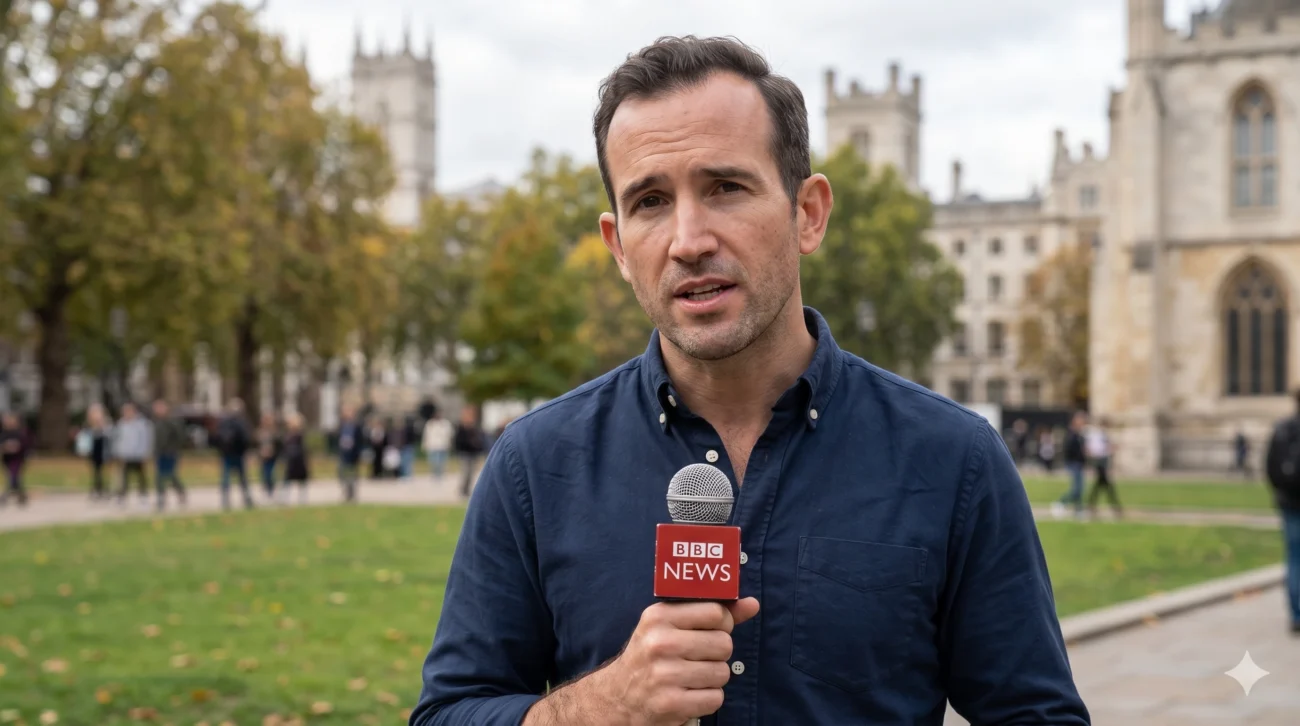
Hugo Bachega is the kind of journalist most people discover in a moment of crisis. For many viewers, that moment came during a live BBC broadcast from Kyiv in October 2022, when the distant sound of incoming missiles cut through his report and forced him and his crew to take cover. The clip moved quickly across social media because it showed, without staging or commentary, what foreign correspondents often ask audiences to understand from a distance. Bachega was not performing danger; he was doing his job while the danger arrived around him.
That moment did not create his career, but it widened public awareness of it. Long before many viewers began searching his name, Bachega had been building the profile of a serious international reporter, moving between breaking news, conflict coverage, political reporting, and the quieter work of explaining why events matter. His byline has appeared in BBC coverage of Ukraine, Lebanon, Gaza, Israel, Hezbollah, and wider Middle East tensions. He is not a celebrity journalist in the usual sense, and that is part of what makes the public interest around him unusual.
People search for Hugo Bachega because they recognize the face, the voice, or the byline, then find that reliable personal information is limited. Some websites publish confident claims about his age, wife, family, religion, salary, and net worth, but many of those claims are not backed by firm public evidence. A responsible biography has to work with that reality instead of pretending every private detail is available. What can be told with confidence is the story of a foreign correspondent whose public identity rests on difficult reporting, careful language, and the trust placed in him by one of the world’s most watched news organizations.
Early Life and Family Background
Hugo Bachega is widely described online as having Brazilian roots, and his name has long appeared in connection with Portuguese-language journalism as well as English-language reporting. That background helps explain why many readers associate him with Brazil, though exact details about his birthplace, childhood, parents, and early family life are not clearly confirmed in the public record. Unlike entertainers, politicians, or public campaigners, foreign correspondents often do not keep detailed personal biographies in circulation. In Bachega’s case, the public record is strongest around his journalism rather than his private life.
That absence should not be mistaken for mystery in the dramatic sense. Many working journalists, especially those who cover armed conflict and political violence, keep family information out of public view for practical reasons. Their work can involve governments, military forces, armed groups, grieving families, and polarized audiences. Privacy is not only a personal preference in that world; it can be part of staying safe and keeping relatives away from unwanted attention.
What can be said is that Bachega’s professional path suggests a journalist comfortable across cultures, languages, and news traditions. His work reflects the habits of someone trained to move between local detail and international context. He has reported for a global audience while covering places where history, language, identity, and politics can make even simple descriptions difficult. That kind of career rarely happens by accident.
Education and Early Ambitions
There is no widely verified public account of Hugo Bachega’s schooling, university education, or first steps into journalism. Some online profiles make claims about his education, but they often do so without naming documents, interviews, or reliable institutional records. For that reason, those details should be treated with care rather than repeated as settled fact. In a fact-checked biography, uncertainty is better than false precision.
Still, the skills visible in Bachega’s work point to a reporter shaped by strong newsroom discipline. He writes and speaks with the directness expected in broadcast journalism, where information has to be clear on the first hearing. He also works in the more layered format of written analysis, where context and attribution matter as much as speed. Those abilities usually come from years spent inside demanding news environments.
His career also suggests early ambition toward international reporting rather than a narrow local beat. Foreign correspondence requires more than fluency in news writing; it demands composure, judgment, source awareness, and a willingness to work where events are unstable. Bachega’s later assignments show a reporter prepared for that pressure. Whatever his exact educational route, his professional formation is visible in the work itself.
Career Beginnings and Move Into International News
Before becoming a familiar BBC name to many English-speaking viewers, Hugo Bachega appears to have built a career across international and Brazilian-linked media spaces. His byline history connects him with major news outlets and syndicated reporting environments, showing the path of a journalist who moved beyond one national audience. That kind of progression is common among correspondents who begin with regional expertise and then earn wider assignments. It also reflects the BBC’s long reliance on multilingual, internationally minded journalists.
The early stages of such a career are often less visible than the later live reports from war zones. Reporters build trust through routine assignments, clean copy, strong sourcing, and the ability to file under pressure. Editors remember the people who can handle confusing developments without overstating what is known. By the time a correspondent appears in a major breaking-news role, a long record of newsroom reliability usually sits behind that moment.
Bachega’s public career follows that pattern. He did not become recognizable through commentary or self-promotion. He became recognizable through reporting, especially during crises where audiences needed someone on the ground to explain fast-changing events. His professional reputation is tied to presence, steadiness, and the discipline of staying with facts while the news is still moving.
The BBC Years
Hugo Bachega is best known today as a BBC journalist and foreign correspondent. His BBC work has placed him in some of the most closely watched conflict stories of the past several years, including Russia’s war in Ukraine and the continuing conflicts and political crises across the Middle East. The BBC’s global reach means his reporting often travels far beyond the immediate audience of one television bulletin. A live report, written article, or recorded package can be seen, quoted, or republished across multiple platforms.
Working for the BBC also places a correspondent under unusual scrutiny. The organization is watched closely by governments, advocacy groups, media critics, and ordinary viewers who bring strong views to subjects such as Israel, Gaza, Hezbollah, Lebanon, Russia, and Ukraine. In those conditions, every phrase can be challenged. A correspondent has to report clearly while knowing that claims, labels, and omissions may all be contested.
Bachega’s role inside that system appears to be that of a field reporter trusted with difficult stories. His work is not built around studio punditry or opinion. It is grounded in location reporting, official statements, eyewitness accounts, and the human consequences of war. That distinction matters because it separates him from commentators who analyze events from afar.
The Kyiv Broadcast That Made Viewers Look Twice
On October 10, 2022, Hugo Bachega was reporting live from Kyiv as Russia launched strikes across Ukraine. During his broadcast, an explosion was heard nearby, followed by the kind of pause that live television rarely forgets. The BBC cut away as Bachega and the crew moved to safety. The moment was brief, but it captured the risk that sits behind even the calmest field report.
What made the clip so striking was not drama in the usual television sense. Bachega had been doing what correspondents do every day: explaining what had happened, what officials were saying, and what the latest attacks meant for civilians. Then the war entered the frame. Viewers saw the distance between reporter and story disappear.
The incident spread widely because it made visible something audiences often understand only in theory. Foreign correspondents in war zones are not simply observers standing outside events. They are often close enough to hear strikes, feel blasts, and make immediate decisions about whether to keep reporting or seek shelter. Bachega’s return to air after taking cover showed the quiet professionalism that defines much of his work.
Reporting From Ukraine
Bachega’s reporting from Ukraine placed him inside one of the defining international stories of the early 2020s. Russia’s full-scale invasion in February 2022 created a sustained demand for correspondents who could explain battlefield developments, civilian suffering, diplomatic pressure, and the experience of cities under attack. Kyiv became not only a capital under threat but also a central stage for global journalism. Reporters there had to balance immediacy with caution.
Ukraine coverage required special care because the information environment was highly contested. Russian officials, Ukrainian authorities, military analysts, local witnesses, and international monitors all shaped the flow of claims. In that setting, a responsible correspondent could not simply repeat the loudest line. The job was to tell viewers what was known, what was claimed, and what still needed confirmation.
Bachega’s work from Ukraine fits the wider tradition of BBC foreign reporting in wartime. It was measured rather than theatrical, direct rather than emotional. The power of his reports came from proximity and restraint. He showed that calm delivery can be more revealing than dramatic language.
Focus on the Middle East
In recent years, Hugo Bachega’s public reporting has been closely associated with the Middle East, especially Lebanon and the wider conflict involving Israel, Hezbollah, Gaza, and regional actors. He has reported from Beirut and southern Lebanon, covering Israeli strikes, ceasefire efforts, civilian casualties, displacement, and Hezbollah’s position in Lebanese society. This beat is one of the hardest in international news because almost every word carries political weight. Even basic descriptions can be disputed by different sides.
Lebanon is a demanding base for a correspondent. The country’s politics are shaped by sectarian power-sharing, economic collapse, foreign influence, armed factions, and the long shadow of past wars. Hezbollah is both an armed movement and a political force with deep roots in parts of Lebanese society. Reporting on that reality requires clarity without simplification.
Bachega’s Middle East work often sits at the point where individual suffering meets regional strategy. A strike on a village, a funeral in Beirut, or a ceasefire violation is not only a local event. It may also speak to Israeli security policy, Hezbollah’s military posture, Iran’s influence, Lebanese state weakness, and the consequences for civilians caught between armed powers. The strongest field reporting helps readers hold all of that in view without losing sight of the people most affected.
Reporting Style and Professional Reputation
Hugo Bachega’s reporting style is controlled, spare, and practical. He does not appear to build his public profile through personality-driven journalism. Instead, he uses the traditional tools of foreign correspondence: location, observation, attribution, and context. That makes his work especially suited to stories where too much certainty can become misleading.
On air, he tends to speak in a steady, clear rhythm, giving viewers what they need without crowding the report with unnecessary flourish. In written pieces, his work often places a human scene inside a broader political frame. That structure is useful in conflict reporting because readers need both the ground-level consequence and the larger reason it matters. A destroyed home or grieving family matters on its own, but it also belongs to a wider chain of decisions and events.
His professional reputation, from the available public record, rests on being a serious BBC correspondent rather than a media personality. That may be less flashy, but it is more durable. In a time when many journalists become known through argument, branding, or social media conflict, Bachega’s profile is still rooted in reporting. That is why readers searching his name often find more bylines than personal interviews.
Public Image and Viewer Interest
The public image of Hugo Bachega is shaped by three things: his BBC role, his calm presence in dangerous settings, and the limited amount of personal information available about him. That combination often produces curiosity. Viewers hear an accent, see a live report from a conflict zone, or read his name on a major story, then want to know more. Search engines reward that curiosity with a mix of reliable article archives and weaker biography pages.
Bachega’s accent has become one of those small details viewers notice, especially because broadcast audiences often form impressions quickly from voice and delivery. Some people search for where he is from based on how he speaks. That curiosity is natural, but it can slide into speculation when websites try to turn a voice into a full biography. A person’s accent may hint at history, but it is not a complete record.
The more meaningful part of his public image is trust under pressure. In live reporting, viewers often judge correspondents by whether they seem clear, fair, and composed. Bachega’s reports have given him the image of someone who can explain danger without turning it into spectacle. For a foreign correspondent, that is one of the hardest balances to keep.
Marriage, Family, and Private Life
Hugo Bachega has not made his marriage, partner, children, or close family life a major part of his public identity. There is no strong public confirmation of a spouse or children from the reliable record available. Some websites claim details about his personal life, but those claims often lack sourcing and should not be treated as verified. In a serious biography, the honest answer is that his private family life remains private.
That privacy is especially understandable given his work. Reporters covering wars, armed groups, and state violence can become targets of online abuse or political anger. Their relatives may also be drawn into attention they did not choose. Many correspondents keep personal information separate from their public work for that reason.
This does not make Bachega less knowable as a public figure. It simply means the known story is a professional one. Readers can assess his journalism through his reporting record, his assignments, and the way he handles difficult stories. They do not need unverified family details to understand his public significance.
Salary, Income, and Net Worth
Hugo Bachega’s exact salary and net worth are not publicly confirmed. As a BBC correspondent, his income would come primarily from journalism work, but the BBC does not publish detailed salary information for most individual reporters unless they fall within specific high-earning disclosure categories. Claims about his net worth on biography sites should be treated as estimates at best. In many cases, they appear to be guesses rather than figures based on financial records.
Foreign correspondents may earn salaries that reflect experience, location, risk, and seniority, but public estimates can vary widely. Some websites publish numbers because readers search for them, not because the numbers are independently verified. Without property records, company filings, disclosed contracts, or direct confirmation, a precise net worth figure would be irresponsible. The fairest statement is that Bachega appears to have a stable professional career with a major international broadcaster, but his personal finances are private.
This distinction matters because net worth culture often turns working journalists into subjects of speculation. Unlike actors, athletes, or business founders, correspondents usually do not have publicly visible endorsement deals, box-office grosses, or company valuations. Their professional value is measured less in wealth than in credibility, access, and newsroom trust. In Bachega’s case, those are the indicators that can be discussed with confidence.
Awards, Recognition, and Industry Standing
There is no widely established public record of major individual awards attached to Hugo Bachega’s name. That does not mean his work lacks standing. Many foreign correspondents build respected careers without becoming award-season figures or household names. Their recognition often comes inside newsrooms, among editors, and through repeated assignment to difficult stories.
Being trusted with major BBC foreign coverage is itself a sign of professional standing. News organizations do not send inexperienced or unreliable reporters into high-risk live environments without a strong basis for confidence. Bachega’s work across Ukraine and the Middle East shows that he has been repeatedly placed close to major events. That pattern speaks more clearly than a public trophy list.
His wider recognition among viewers likely grew from the Kyiv broadcast and continued through his Middle East reporting. In modern journalism, a single live clip can introduce a correspondent to millions, but long-term reputation depends on what comes after. Bachega’s continuing presence in major coverage suggests that the viral moment did not overshadow the work. It became one visible point in a larger career.
Setbacks, Scrutiny, and the Pressure of the Beat
Any journalist covering Israel, Gaza, Lebanon, Hezbollah, Ukraine, or Russia works under intense scrutiny. Audiences bring strong moral, political, and personal commitments to these stories. Advocacy groups and governments often monitor coverage closely, challenging labels, sources, omissions, and framing. Bachega’s reporting exists inside that pressure, as does the work of nearly every correspondent on these beats.
Some criticism of BBC Middle East coverage has touched reports carrying Bachega’s name or involving his field work. That is not unusual for correspondents covering contested conflicts. Critics may argue that a report should have used different language, added more historical context, identified a group more sharply, or treated official claims with greater skepticism. In such debates, the line between fair editorial critique and political pressure can be difficult to draw.
The important point is not that scrutiny exists, but how a reporter’s work holds up under it. Conflict journalism should be questioned because the stakes are high. At the same time, criticism should be specific and evidence-based rather than personal. Bachega’s public record shows a reporter working in exactly the kind of space where precision is both essential and constantly contested.
Where Hugo Bachega Is Now
Hugo Bachega remains publicly identified with BBC foreign reporting, especially coverage of the Middle East. Recent records place him in connection with reporting from Beirut and southern Lebanon, where the consequences of Israeli strikes, Hezbollah activity, ceasefire efforts, and civilian displacement continue to shape the news. His current status is best understood through that work rather than through personal publicity. He appears to be active as a correspondent on major international stories.
The Middle East assignment keeps him close to some of the world’s most unstable and closely watched developments. Lebanon’s fragility, Gaza’s humanitarian crisis, Israel’s security concerns, Iran’s regional role, and the politics of armed groups all feed into the stories a correspondent in the region must explain. That requires more than being present. It requires historical memory, careful sourcing, and the humility to say what cannot yet be known.
For readers looking for a simple answer, Bachega is a BBC journalist whose career has moved through some of the defining conflicts of the past several years. He is not best understood through rumors about his age or private life. He is best understood through the work: live reports, written dispatches, and the demanding craft of telling the public what is happening while events are still unfolding.
Frequently Asked Questions
Who is Hugo Bachega?
Hugo Bachega is a BBC journalist and foreign correspondent known for reporting on Ukraine and the Middle East. His work has included coverage from Kyiv, Beirut, southern Lebanon, and other locations tied to major international conflicts. He is most visible to the public through BBC broadcasts and written reports on war, politics, and regional crises.
Where is Hugo Bachega from?
Hugo Bachega is widely described as having Brazilian roots, and his career has connections to Portuguese-language and international journalism. Exact public details about his birthplace and early family life are limited, so claims about his background should be handled carefully. What is clearly established is his professional identity as a BBC foreign correspondent working for a global audience.
Is Hugo Bachega married?
There is no reliable public confirmation of Hugo Bachega’s marital status. Some websites make claims about his wife or partner, but those claims are not strongly sourced. Because he covers sensitive international stories, his decision to keep personal life private is understandable.
What is Hugo Bachega’s net worth?
Hugo Bachega’s net worth is not publicly confirmed. Online estimates should be treated as guesses unless they are tied to verifiable financial records or direct disclosure. His known income source is his work as a journalist, especially his role with the BBC.
Why did Hugo Bachega become widely known?
Many viewers became aware of Hugo Bachega after a BBC live broadcast from Kyiv in October 2022, when explosions interrupted his report and he had to take cover. The clip spread widely because it showed the danger faced by journalists reporting from war zones. His later reporting from the Middle East has kept his name visible among BBC audiences.
What does Hugo Bachega report on now?
Hugo Bachega is strongly associated with BBC coverage of the Middle East, including Lebanon, Hezbollah, Israel, Gaza, and ceasefire developments. He has also reported from Ukraine during Russia’s war there. His current work centers on explaining conflict, civilian impact, political claims, and regional consequences.
Does Hugo Bachega have a Wikipedia page?
Hugo Bachega does not appear to have a widely established standalone Wikipedia biography in the public record most readers encounter. That absence does not mean he lacks professional credibility. Many respected journalists are best documented through their bylines, employer pages, live reports, and media databases rather than encyclopedia entries.
Conclusion
Hugo Bachega’s biography is not the story of a public figure who has invited attention into every corner of his life. It is the story of a journalist whose name became familiar because he stood close to events that shaped the world’s headlines. His public identity is built through reporting rather than self-display. That makes the available record narrower, but also clearer.
The strongest facts about him are professional ones. He is a BBC foreign correspondent associated with major coverage from Ukraine and the Middle East. He has reported from dangerous places, explained contested events, and worked in settings where accuracy can carry real human consequences. That is the core of his public importance.
What remains private should be allowed to remain private unless Bachega chooses otherwise. The search for biography should not become an excuse to repeat weak claims about family, money, religion, or relationships. In his case, restraint is not a gap in the story; it is part of telling the story properly.
Bachega matters because reporters like him help distant audiences understand wars that might otherwise appear only as headlines, casualty figures, and political slogans. His work sits in the difficult space between witness and explanation. As long as conflicts in Ukraine and the Middle East continue to shape global affairs, journalists with his discipline will remain essential to how the public sees the world.
